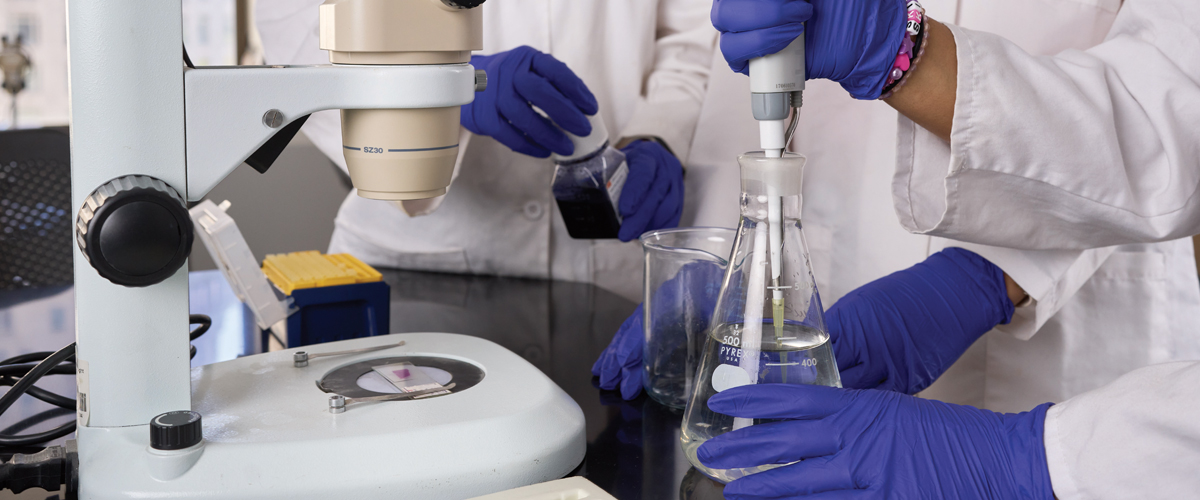
Faculty Secure Federal Research Grants
This summer, multiple research projects led by New York Tech professors received competitive awards from federal agencies, including the National Institutes of Health (NIH) and the National Science Foundation (NSF).
The projects, which collectively total more than $2.8 million, span the fields of biomedical sciences, engineering, mathematics, physics, and psychology. Captained by faculty from the College of Arts and Sciences, College of Engineering and Computing Sciences, and College of Osteopathic Medicine (NYITCOM), the studies also provide students with hands-on opportunities to participate in the scientific process and gain valuable insights from research mentors.
“The Office of Sponsored Programs and Research remains committed to providing the university’s scholars with the necessary guidance, resources, and support to develop high-quality grant proposals and effectively manage funded awards. We congratulate these talented investigators and look forward to additional opportunities that allow us to collaborate with faculty and expand New York Tech’s research impact,” says Vice Provost for Research Jared Littman, Ph.D.
NIH Awards
- Robert Alexander, Ph.D., assistant professor of psychology and counseling, secured a four-year award in support of eye movement research that examines how radiologists interact with data from artificial intelligence (AI) tools. The project addresses a critical patient safety challenge: missed detections in radiology, a leading cause of medical error. New York Tech students will be directly involved in data collection, analysis, and national conference presentations, gaining paid, hands-on biomedical research experiences that will position them for competitive graduate, medical, and technical careers. To date, Alexander has received $131,800 in funding, with a total of $589,210 anticipated over the course of the project.[i]
- Raddy L. Ramos, Ph.D., associate professor of biomedical sciences, received a three-year $459,000 grant, which will fund anatomical studies to reveal the molecular identity of cells present in brain malformations, as well as other studies exploring how cells are abnormally organized and interconnected, leading to seizures. Leveraging state-of-the-art microscopy equipment in the Biomedical Research, Innovation, and Imaging Center, the project will also involve the expertise of fellow neuroscientists Gonzalo Otazu, Ph.D., and Randy Stout, Ph.D., as well as assistance from medical students, including NYITCOM student Justin Popp, and New York Tech undergraduates.[ii]
- Jennifer Xie, Ph.D., associate professor of biomedical sciences, was awarded a three-year $472,592 grant for research to uncover new migraine treatments for patients who do not respond to or cannot take commonly prescribed medications. Using migraine models, Xie and her research team, including NYITCOM students Kaku Asare, Helen Shi, and Annalee Uhrlaub, will adopt a mix of behavioral and biological methods to explore whether the new compound RgIA-5474, which targets the immune system (specific receptors called α9α10 nicotinic acetylcholine receptors), reduces migraine-like pain and benefits patients lacking effective medications. In 2020, Xie received an NIH grant for a separate project exploring whether osteopathic manipulative treatment helps relieve migraines.[iii]
- Haotian Zhao, M.D., Ph.D., professor of biomedical sciences, secured a three-year $459,000 grant in support of his ongoing research into the complex processes responsible for choroid plexus carcinoma (CPC), a rare but lethal brain tumor occurring primarily in children. While Zhao’s previous federally funded project studied tumor development in animals, recent findings suggest some CPC-related biological processes in humans cannot be replicated in other species. Using human organoids, this parallel project will address knowledge gaps and uncover the role of non-coding RNA in CPC development. Co-collaborators include NYITCOM students Navjot Guru and Leah Wachsmuth, as well as undergraduates Siya Patel (biology), Heemali Patel (life sciences), Dua Hanif (health sciences), Mahek Chaudry (health sciences), and Asiye Susoglu (biology).[iv]
NSF Awards
- N. Sertac Artan, Ph.D., associate professor of electrical and computer engineering, and Cecilia Dong, Ph.D., professor of electrical and computer engineering, secured a three-year grant totaling $464,173 for research to enhance the security and experience of online activities. While online health advice is often unreliable, malicious apps can steal confidential health information. To determine how online activities impact users, the researchers will collect physiological data from wearables, virtual reality headsets, and non-invasive brain imaging techniques, which will be analyzed via machine learning and other modeling techniques. The project will be completed as part of the Research Experiences for Undergraduates (REU) program.[v]
- Yusui Chen, Ph.D., associate professor of physics, secured a two-year $149,999 award for a project addressing two national needs: closing a critical workforce gap in the fields of quantum computing and cybersecurity, and investigating how quantum technologies can help solve significant cybersecurity challenges. Chen will develop an educational, cloud-based platform that blends quantum computing and cybersecurity through hands-on, collaborative learning experiences for high school students and undergraduates. New York Tech faculty and students, including undergraduates David Rogala (electrical and computer engineering), Faraz Khan (physics), and Abel Mekuria (computer science), will collaborate with colleagues at the University of South Florida on course development, module testing, and implementation.[vi]
- Baole Wen, Ph.D., assistant professor of mathematics, received a two-year $249,995 grant to investigate how heat and momentum are transported in thermally driven fluids under extreme conditions. His findings could provide insight into the fundamental physics of convection (heat transfer in fluids) and contribute to understanding planetary and solar system dynamics. Undergraduates engaged in the project include Abdul Raafay Irfan (mechanical engineering), as well as Kyle Stephens (applied and computational mathematics) and Dayshaun Kalra (mechanical engineering). Stephens and Kalra will participate via research-based coursework, including the Mathematical Fluid Dynamics course and the Department of Mathematics’ Annual Math Day, which connects students from regional colleges and high schools through shared research experiences.[vii]
[i] Research reported in this publication was supported by the National Institute of General Medical Sciences of the National Institutes of Health under Award Number 1R16GM159810-01. The content is solely the responsibility of the authors and does not necessarily represent the official views of the National Institutes of Health.
[ii] Research reported in this publication was supported by the National Institute of Neurological Disorders and Stroke of the National Institutes of Health under Award Number 1R15NS137226-01A1. The content is solely the responsibility of the authors and does not necessarily represent the official views of the National Institutes of Health.
[iii] Research reported in this publication was supported by the National Institute of Neurological Disorders and Stroke of the National Institutes of Health under Award Number 1R15NS143081. The content is solely the responsibility of the authors and does not necessarily represent the official views of the National Institutes of Health.
[iv] Research reported in this publication was supported by the National Cancer Institute of the National Institutes of Health under Award Number 1R15CA287297-01A1. The content is solely the responsibility of the authors and does not necessarily represent the official views of the National Institutes of Health.
[v] This project is funded by NSF Award No. ID 2447577. The content is solely the responsibility of the authors and does not necessarily represent the official views of the NSF.
[vi] This project is funded by NSF Award No. ID 2519355. The content is solely the responsibility of the authors and does not necessarily represent the official views of the NSF.
[vii] This project is funded by NSF Award No. ID 2532634. The content is solely the responsibility of the authors and does not necessarily represent the official views of the NSF.
More News
The Domino Effect
New York Tech’s Research Experiences for Undergraduates program has spent more than a decade turning summer research opportunities into lasting careers, helping build the university’s research reputation along the way.
New York Tech To Be Ranked Among National Universities
For the 2027 U.S. News & World Report annual rankings, New York Tech will be included in a new ranking category—National Universities.
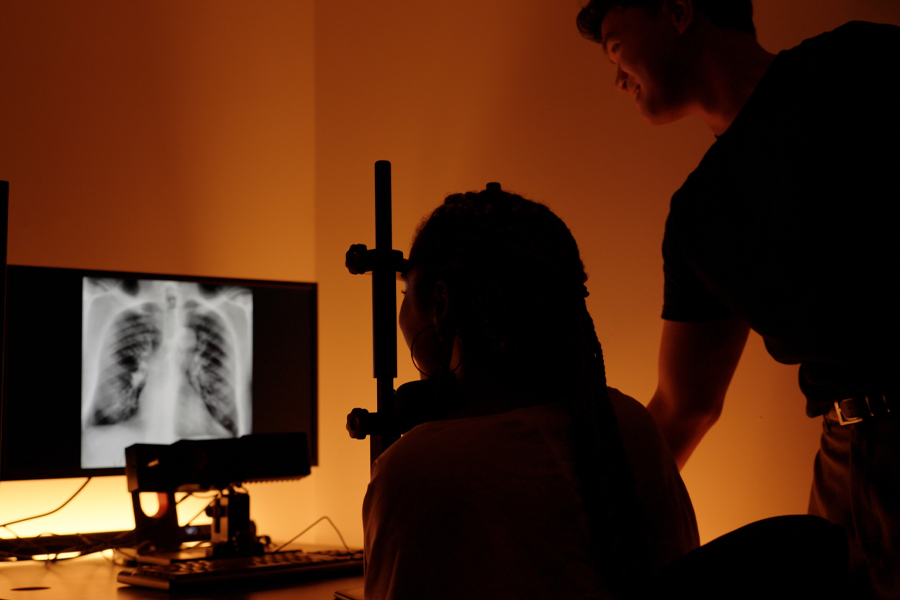
Exploring How AI Tools Can Improve Lung Cancer Detection
Research by Assistant Professor Robert Alexander, Ph.D., and student Talia Lilikakis assesses how AI tools can most effectively alert radiologists of the possible presence of a nodule.
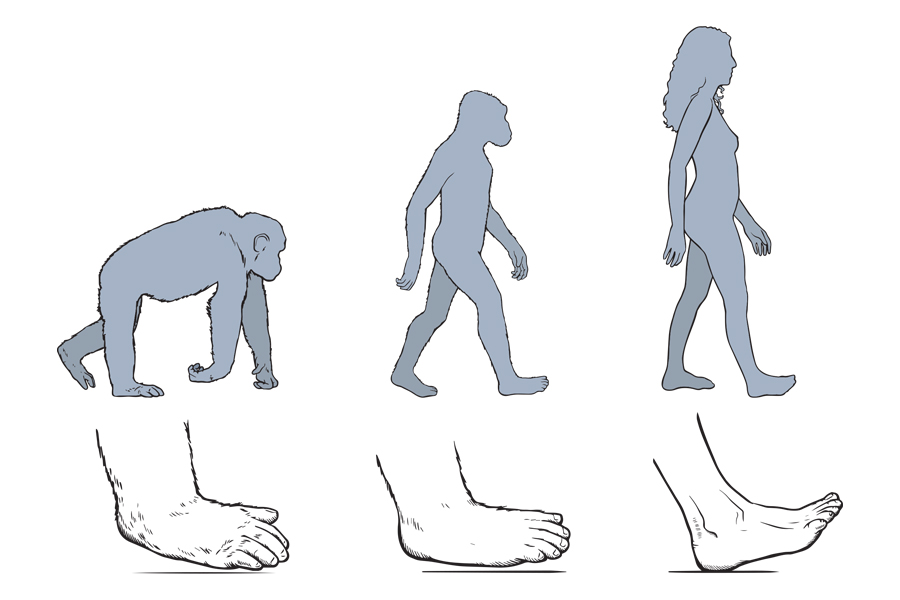
The Evolutionary Significance of Humans’ Unique Heel-Toe Walking Pattern
Associate Professor of Anatomy Nathan E. Thompson, Ph.D., contributes to research unveiling clues to the origin of humans’ stride pattern.
Robust Research
New York Tech’s commitment to research paves the way for important and groundbreaking work. Meet three Ph.D. students whose work may improve disaster response, recovery after muscle and bone injuries, and anticancer therapies.
NYITCOM-Arkansas’ Rajagopalan Receives $573K NIH Grant for Cardiovascular Disease Research
The funding will further Associate Professor Viswanathan Rajagopalan’s research regarding the impact thyroid dysfunction has on cardiovascular disease.