The Evolutionary Significance of Humans’ Unique Heel-Toe Walking Pattern
The average human takes thousands of steps every day, and for most, those steps follow the same pattern: hitting the heel of the foot and then rolling through the toes. But why do humans walk the way they walk? Unlike our closest primate relatives, humans are the only primates that consistently walk with a heel-toe pattern.
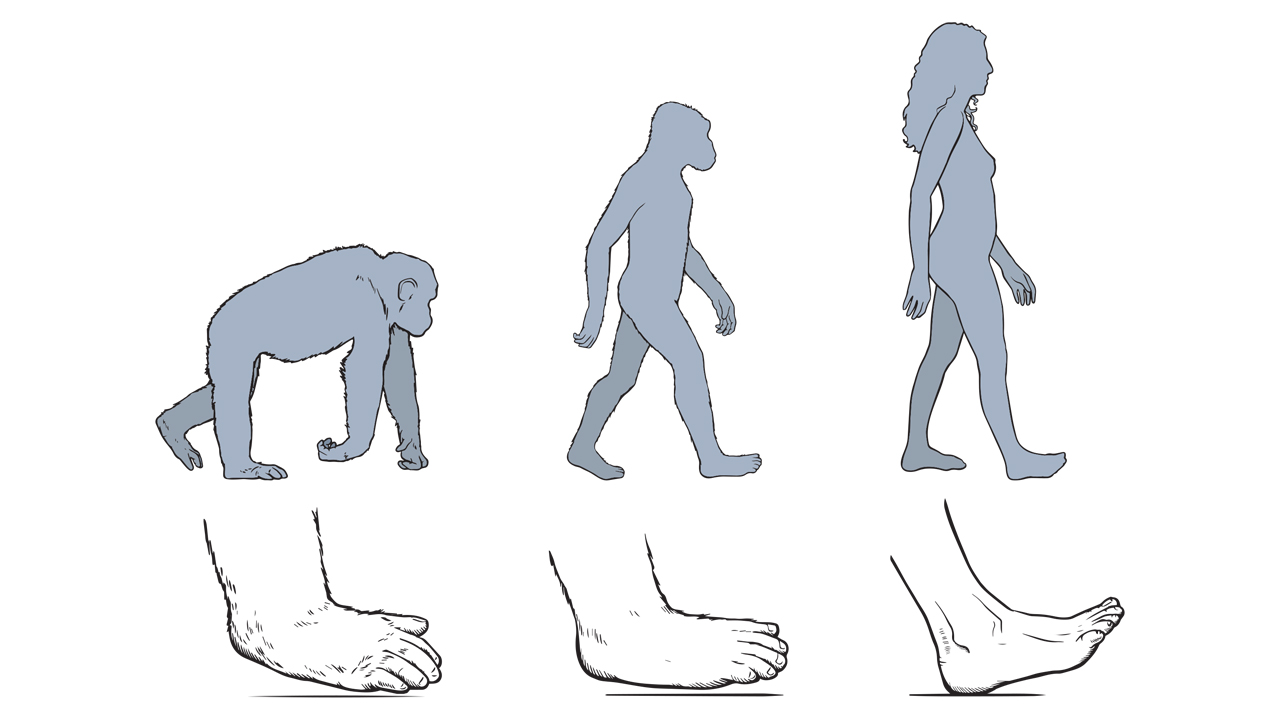
Until recently, scientists could only speculate about the significance of this unique heel-toe walking pattern on human evolution. Now, new research published this month in the Proceedings of the National Academy of Sciences of the United States of America (PNAS), one of the world’s most-cited and peer-reviewed multidisciplinary scientific journals, provides answers to this evolutionary question.
The research team, including Nathan Thompson, Ph.D., associate professor of anatomy at the College of Osteopathic Medicine (NYITCOM), collected a wealth of data comparing the walking patterns of chimpanzees and humans.
Thompson, along with his colleagues Nicholas Holowka, Ph.D., assistant professor at Penn State University, and Matthew O’Neill, Ph.D., associate professor at Midwestern University, has been studying the evolution of human walking since 2010.
Using highly detailed 3-D motion capture of both humans and chimpanzees, the researchers identified distinct walking patterns between the species. They found that chimpanzees frequently vary their walking style by landing on the ball or side of the foot when walking on two legs, exhibiting a greater range of foot-strike angles compared to the human participants, who often did not heel-strike at all.
Another interesting finding noted that heel-strikes led to a higher impact load, the force applied to the foot, than other stride patterns.

“Imagine you are trying to sneak across a creaky wooden floor,” explains Thompson. “You tend to walk on the balls of your feet, because this reduces the rate of loading on the floor and creates less creaking. It’s a softer way to walk. Our data shows that chimpanzees prefer the ‘softer’ way to land when walking on their feet.”
If a heel-toe pattern of walking increases impact load on the joints, why did humans evolve to walk this way? To address this question, the research team measured metabolic energy costs in human participants and discovered that walking with midfoot strikes expended 26 to 41 percent more energy than walking with a heel-first stride.
These more impactful forces could have potentially been damaging to the body and ultimately required later adaptations to allow early humans to walk in a safe, consistent way, according to the researchers.
“It seems like humans needed to evolve anatomical adaptations—thicker heel bones and bigger knee and ankle joints—to cope with these high forces,” shares Holowka, lead author on the paper. “We think that the heel-strike played a role in enabling key human behaviors, such as using hunting and gathering strategies that require people to walk really long distances every day to get food, but for a big payoff in food resources.”
Adds Thompson, “Walking on two legs with the heel-strike pattern—while not the best strategy in terms of force—may have provided our early ancestors with enough energy to explore, traveling longer and further than any other primate.”
More News

New York Tech To Be Ranked Among National Universities
For the 2027 U.S. News & World Report annual rankings, New York Tech will be included in a new ranking category—National Universities.
Robust Research
New York Tech’s commitment to research paves the way for important and groundbreaking work. Meet three Ph.D. students whose work may improve disaster response, recovery after muscle and bone injuries, and anticancer therapies.
NYITCOM-Arkansas’ Rajagopalan Receives $573K NIH Grant for Cardiovascular Disease Research
The funding will further Associate Professor Viswanathan Rajagopalan’s research regarding the impact thyroid dysfunction has on cardiovascular disease.

NYITCOM Student Receives American Heart Association Scholarship
A student researcher from the College of Osteopathic Medicine (NYITCOM) has secured the prestigious Student Scholarship in Cardiovascular Disease from the American Heart Association.

Fellows’ Field Notes: Bofan He and Christine Lee
Edward Guiliano Global Fellowship recipients Bofan He and Christine Lee reflect on their experiences as they traveled to conduct academic research.

Where Medicine and Artificial Intelligence Converge
As a first-year medical student, Sungjoon Hong worked on research that focuses on ways AI can be used to help comfort and heal the human body.