Staff & Faculty Directory
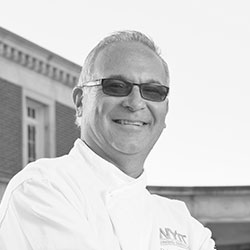
Robert Rizzuto
Director, Dining Services; NYIT de Seversky Mansion
Robert Rizzuto, whose career as a chef spans more than four decades, is the director of dining service at New York Institute of Technology. In this role, he oversees NYIT de Seversky Mansion and the campus dining program for university students on Long Island and in New York City.
Robert Rizzuto is a graduate of the renowned Culinary Institute of America (CIA) in Hyde Park, N.Y., yet describes his entrée into what has become his life’s work as “something he fell into.” In fact, his journey to train with and study under some of the world’s top chefs, including Daniel Boulud, Charlie Palmer, Christian Delouvrier, and Alain Ducasse, as well as Guy Martin at Château de Divonne, in Divonne-les-Bains, France, among others, began unsuspectingly when he was a teen-aged basketball player.
The Early Years
Robert learned about the CIA while in high school; his uncle was the director of education there and an executive chef at a nearby summer camp, which Robert attended as a camper and worked as a waiter, a dining room server, and a stand-in sous chef.
“Would you like to jump into the kitchen to try and help?” he remembers his uncle asking. Chef Eddie Kerr, who became a mentor to Emeril Lagasse, worked as a line chef at the summer camp, and Robert helped prep food. “Well, I started to fall in love with it,” he shared.
After a few more seasons of high school basketball and summers at the camp, Robert received a scholarship to play basketball, which was quite fitting in an athletic family that counted New York Yankees legend Phil Rizzuto as a relative.
However, Robert wanted to pursue cooking. With his family’s blessing and full support, he began his formal training at the CIA, earning an associate’s degree. Claiming he actually paid more attention to developing his craft after he graduated, Robert’s uncle introduced him to Serge David (a born and trained French chef who worked in New York at the St. Regis Hotel, Le Pavilion, and Terrace on the Park, to name a few.) “I invited Serge and Chef Jean-Yves Piquet (the executive chef at Le Cygne in Manhattan) to a wine-pairing dinner at NYIT de Seversky Mansion; I was so proud of the dinner, but Jean-Yves, in his own perfect way, said to me, ‘your food is terrible, but I think I can help you,’” Robert recounts with a smile.
Blessed by Opportunities
“Jean-Yves Piquet says, ‘if you’d like to come on your own time after work and train in the restaurant, I’ll show you some pointers about cooking.’ That is really when it started to resonate that, wow, I am in New York City, training at one of the best restaurants at that time.” Jean-Yves was tough and like most French, was very passionate about cooking. Next, Jean-Yves sent Robert to La Reserve, another French restaurant, to become a stagiare, or apprentice, for the lunch service.
“I was blessed; when I trained at one place, the chefs would talk to each other and continue to send me to other places. My uncle was very influential in my training as well, because although I was a stagiare at these places, he helped me gain access to other chefs. I had tremendous opportunity,” Robert notes.
His early training was a type of initiation, but he stuck with it. His big break, he says, is when he met Daniel Boulud, chef at Le Cirque. Not only did Chef Boulud champion Robert’s continued training, but he also provided opportunities for him to meet other luminaries in top New York restaurants, many of whom became both mentors and friends.
Robert recalls how Chef Boulud included him in a specific catering job at Regine’s, a popular French nightclub in the 1980s. Though still a trainee, thanks to Chef Boulud, Robert met some exceptionally talented, well-known chefs that night, including Alain Ducasse and Christian Delouvrier, as well as celebrities. Only recently did Robert learn that C.Z. Guest, a socialite who had owned a country home on the Gold Coast of Long Island (Templeton), was at Regine’s that same night. For decades now, that former Guest country home has been known as NYIT de Seversky Mansion. The serendipity is not missed on Rizzuto.
Influences and Ongoing Education
A seminal moment in Robert’s training came when he followed Chef Boulud to Daniel, the chef’s signature restaurant. “I did not have a tape recorder in the restaurant, but I was seeing things that intrigued me. The chemistry of food really intrigues me, and I think one of the most important things about being a chef is that you must understand how food comes together and works together. I did not know until I started working in these restaurants that there is a way to build a menu, to create menus and detect different textures, flavors, and lightness,” he explained. Rizzuto would work in NYIT de Seversky Mansion into the afternoon, then drive into New York City and work until after midnight at Daniel. “On the drive home, I would talk into the tape recorder, and list what Chef did.” He then transposed his recordings into a binder, which he still has today. “I still have those notes from all the places where I worked. To this day, I am still learning and changing. I like to watch and see what people are eating or what they are enjoying or not enjoying. I like to be creative, and I am being educated every day.”
He thrives on observing what restaurants are doing and the different plates they put together. “I can learn something by walking into a store and seeing how they are presenting food, or the combinations of food. Education to me is key. Education of and for the team of people that I work with is very important. You cannot stay stagnant.”
Idols in the Kitchen
Some whom Rizzuto has worked under would be called celebrity chefs today, including Alain Ducasse, Charlie Palmer, and David Burke. “For me, they were idols. I had all their books before I even worked with them,” he shared. He had to prove himself in these elite kitchens, demonstrating he was there to train, work hard, and not to steal their recipes! As top restaurant kitchens are a highly competitive environment, some chefs did not want to train “upstarts,” so opportunities had to be leveraged.
Another chef very dear to Robert is Lidia Bastianich, whom he met decades ago when she owned Felidia in New York City, before she produced her cookbooks and television shows. “Lidia was cooking for a Manhasset public school fundraiser, hosted in NYIT de Seversky Mansion. Other staff members and I worked with her, prepped for her, and served dinner that night. We did not know who she was, but we were blown away.” After cleaning her pots and pans and helping her stow them back in her car, Robert recalls Lidia saying, “let’s get together sometime. And from then on, Lidia and I have become quite good friends, and she has taught me a great deal about cooking and the industry. She has just been very gracious.”
Select Highlights Among Many
In 1980, Rizzuto interviewed at the New York Times for the executive chef position. “I will never forget walking into Arthur Sulzberger’s office. I sat down, introduced myself, and he asked about my background. I mentioned that most of my training is in French cooking. And his response to me was, ‘I don’t like French food.’ So, the interview was over quickly, but the experience of meeting this gentleman was unbelievable.”
Another career highlight was interviewing for the sous chef position at the White House. Serge David recommended Robert for the position, and he survived the cut of contenders to 10 candidates, and then was one of two. “Interviewing at the White House was one of the most incredible experiences I have ever had. The executive chef took me on a tour through the state rooms, through the entire White House, and into the kitchens, and we talked a bit about food. I found out that one reason I did not get the position is that President George H. W. Bush did not like French food,” he laughed.
Engaged Food Service Management
About 20 years ago, New York Institute of Technology used a contract service company to manage food service for students. Rizzuto believed his team could manage it and wanted to bring the student dining service in-house. He created a business plan and started small, first with the university’s medical students. Over time, the business plan extended to assume responsibility for all food service for the university’s students, including for the residence hall.
“I remember saying to the staff then, and which I say to this day, is that for us to be successful, it must be about engagement—engaging students, faculty, and staff. We are here for them, to enhance their educational experience, because food service and their dining experiences are a big part of that. We must engage with them and understand their food needs, whether it be dietary, religious, or something else.”
One aspect that Rizzuto says is a rewarding part of his two-pronged job is challenging his team to grow. “There’s no such thing as mediocrity,” he says, noting that “change, listen, and act” is a model that he and his team live by. For example, he works with the culinary medicine program in the university’s College of Osteopathic Medicine. “I like to work with them because they are into nutrition and eager to see how they can bring nutrition into the medical field. I enjoy engaging with the students and sharing the knowledge I have.”
Enhancing students’ dining experiences also led to the creation of a garden on the Long Island campus, which has only expanded. “We’re growing all kinds of vegetables, and we serve them on campus, either at NYIT de Seversky Mansion or in the various student dining locations. We do like to tell students when we are serving bounty that comes from the campus garden. It is fresh and there are no pesticides involved,” he noted.
Rizzuto’s team also thrives on feedback and ideally meeting in person with students. His goal is simple; to talk about how his team can help enhance students’ dining experience or overall student life at New York Tech. “Working with my team and engaging with students, faculty, and staff is the greatest satisfaction of my work,” he notes.
Famous Faces in Historic Mansion
Among too many career highlights to mention, Rizzuto would be remiss to not recount cooking for Billy Joel at NYIT de Seversky Mansion in the fall of 2007. Robert planned a wine-pairing dinner with Roman Roth, the winemaker at Long Island’s Wolffer Estate Winery. It was white truffle season, so he incorporated them into the menu. When he replied to Billy Joel, when asked, that the white truffles that year were not particularly good, Billy readily agreed, and started to play a piano that was brought in. “Dinner started at 7 p.m., and Billy Joel played until 2 a.m.,” Rizzuto shared. Another musician whom Robert and staff met and cooked for was Meatloaf, who filmed a music video in the Mansion.
Additionally, films and television shows have been shot there, including Arthur in 1981. It filmed on the weekends when the mansion was not open. One Monday morning the filming had not yet ended, so the dining services team met Dudley Moore, Liza Minnelli, and Sir John Gielgud, among others, and cooked two lunches for them that week as well. Television shows, including The Blacklist and Royal Pains were filmed on campus, as was The Diplomat.
Other notable guests Rizzuto remembers cooking for include Kareem Abu Jabbar, whom he idolized and followed as a player with the Milwaukee Bucks; and actors James Earl Jones, Lloyd Bridges, Hal Linden, and William Devane. Rizzuto has also cooked for the musician Micky Dolenz and television host Larry King.
When Rizzuto began working at NYIT de Seversky Mansion more than four decades ago, most hosted events were for the university itself, or were corporate events. Rizzuto proposed hosting weddings and other social and private events. Today, the calendar is full of such events, and for charitable organizations the dining team and university support. One example is a thank-you event held each year as a friendly cooking competition for the law enforcement agencies that help to keep the university’s New York campuses safe.
Culinary Aspects of University Life
In higher ed, the main purpose of dining services is to enhance the experience of student life on campus, which makes the environment quite different than a restaurant, cruise ship, or hotel. According to Rizzuto, “We want to be a liaison to bring people in the campus community together, over food. It is important that we get people outside of the office and classroom to engage,” he said.
He is proud of the fact that his culinary team produces everything on campus, focusing on fresh and healthy food. Also, some members of the team have been together for a decade or two; it is noteworthy that Rizzuto and his team have presented several dinners at the James Beard Foundation in New York City. “It is important for me as a manager that my team has the tools that they need, has the clear direction that they need, and are happy. Communication and feedback are key to longevity, which is something I am immensely proud of, especially in the food services industry.”