Staff & Faculty Directory

Kaie Ojamaa
Professor; Biomedical Sciences, College of Osteopathic Medicine
Education Credentials: M.S., Ph.D.
Expertise: Cardiovascular Endocrinology, Molecular Biology
Joined New York Tech: 2017
Kaie Ojamaa was educated in Montreal, Canada, at McGill University. She then earned her Ph.D. in physiology at Penn State University College of Medicine, studying metabolic disease processes. During her post-doc studies at the National Institutes of Health in Washington, D.C., she was part of a team who cloned the first mutant insulin receptor of a patient with an extreme form of insulin resistance. This was followed by years of research at The Feinstein Institute for Medical Research/Northwell Health; New York University; and Hofstra University Zucker School of Medicine. Ojamaa specialized in cardiovascular endocrinology, with a focus on the role of thyroid hormones on cardiac diseases and on the regulatory function of the neuroimmune system in cardiac hypertrophy and heart failure.
Dr. Ojamaa has collaborated with pediatric cardiologists and surgeons at Cohen Children’s Medical Center on Long Island to study the role of the immune function of newborns with congenital heart defects who require corrective or palliative surgery. Currently at NYIT College of Osteopathic Medicine, Ojamaa continues her research of cardiac diseases using molecular and gene analytic tools, super-resolution microscopic imaging, calcium/contractile measurements of cardiac myocytes, and physiological approaches. Her goals are to improve current treatment strategies and to develop new approaches to care.
- National Institutes of Health (National Heart Lung & Blood Institute) 2020–2024 R15HL154068 Thyroid Hormone Regulation of Cardiomyocyte T-tubule Structure and Function
The Ojamaa Lab is studying how the ultrastructural T-tubule network of the cardiac myocyte is remodeled in heart failure, resulting in reduced calcium transients and contractile dysfunction, and how treatment with thyroid hormones can attenuate these adverse changes.
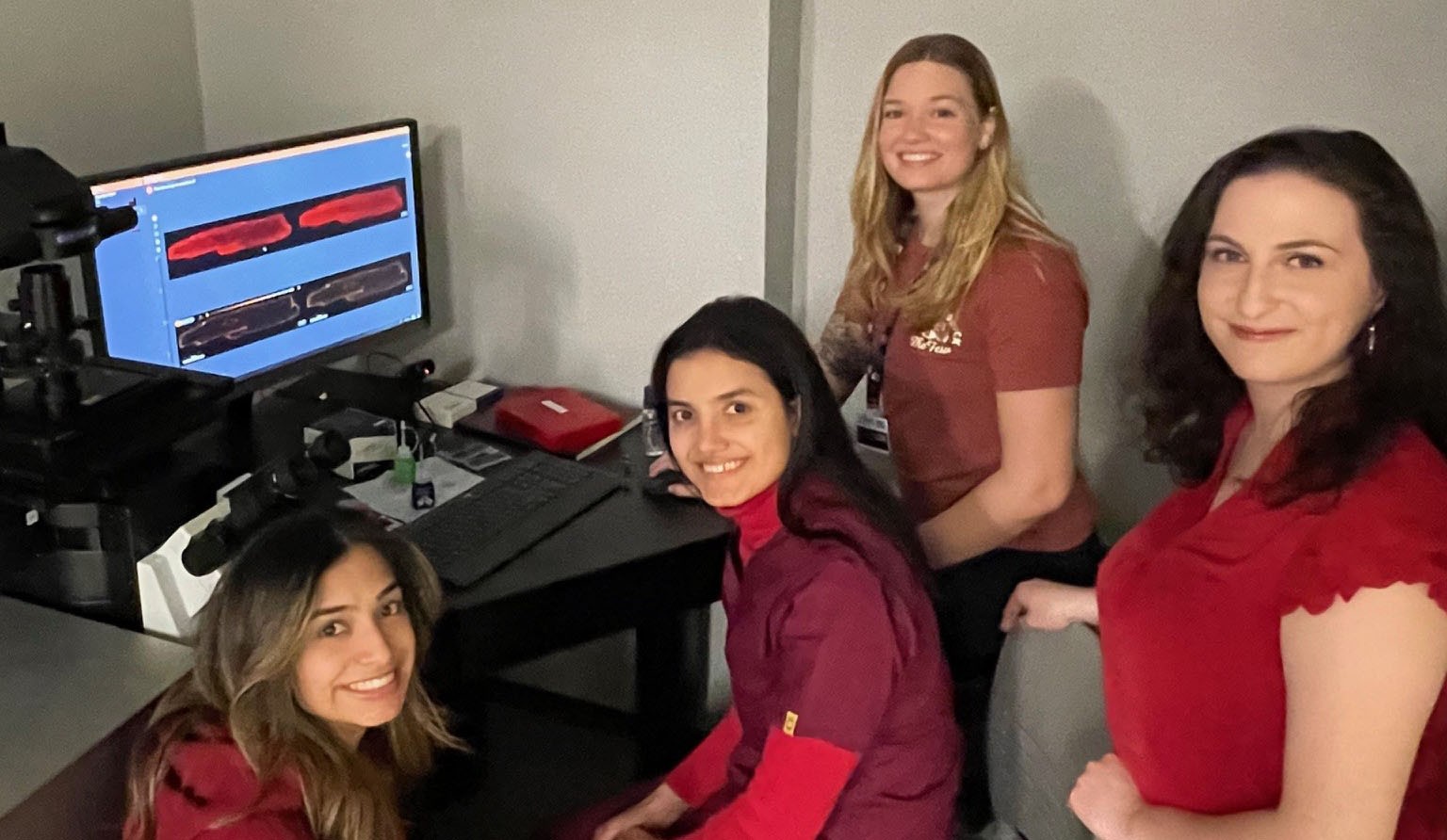
We use nanoscale microscopy (STORM and STED) to visualize single molecule localization to assess the organization of calcium channels in failing hearts, and to determine how changes in co-localization of these channels lead to cardiac dysfunction.
Advanced technologies including the NanoString CosMx™ spatial multiomics single-cell imaging system is being used to visualize and quantify single protein and RNA molecules in situ to monitor cellular processes and phenotypic changes with disease in the brain and heart.
- Cold Spring Harbor Labs, Single Biomolecules Conference. Sept 2022. Amanda Charest, Nicolas Nasta OMS-II, Sumaiyah Siddiqui OMS-II, Randy Stout, Kaie Ojamaa, 2D and 3D SMLM imaging and analysis of cardiomyocytes.
- American Physiological Society Summit, Long Beach, CA, April 2023. Nicholas Nasta OMS-II, Amanda Charest, Sumaiyah Siddiqui OMS-II, Iffat Nur OMS-II, Randy F. Stout, Kaie Ojamaa. Thyroid hormone maintains cardiac dyadic structures by regulating junctophilin-2 localization to Ryanodine clusters.
- AMOPS Conference, Association of Military Osteopathic Physicians and Surgeons, March 2023. Nicholas Nasta OMS-II, Amanda Charest, Sumaiyah Siddiqui OMS-II, Iffat Nur OMS-II, Randy Stout, Kaie Ojamaa. Thyroid hormones maintain cardiac Transverse-tubular structures for efficient excitation-contraction coupling.
- American Physician Scientists Association, NYITCOM chapter, Nov 2023. Atieh Ashkezari OMS-II, Megha Schmalzle OMS-II, Riddhi Modi OMS-II, Nicholas Nasta OMS-III, Amanda Charest, Kaie Ojamaa. Nanoscale organization of calcium channels is disrupted in MI-induced heart failure.
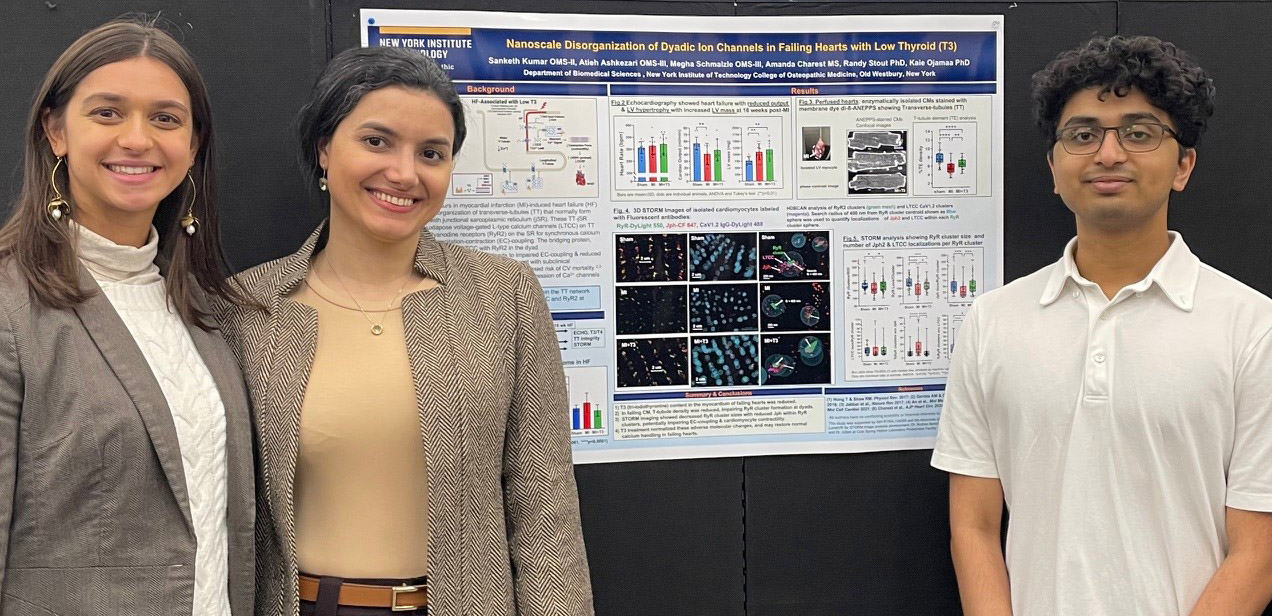
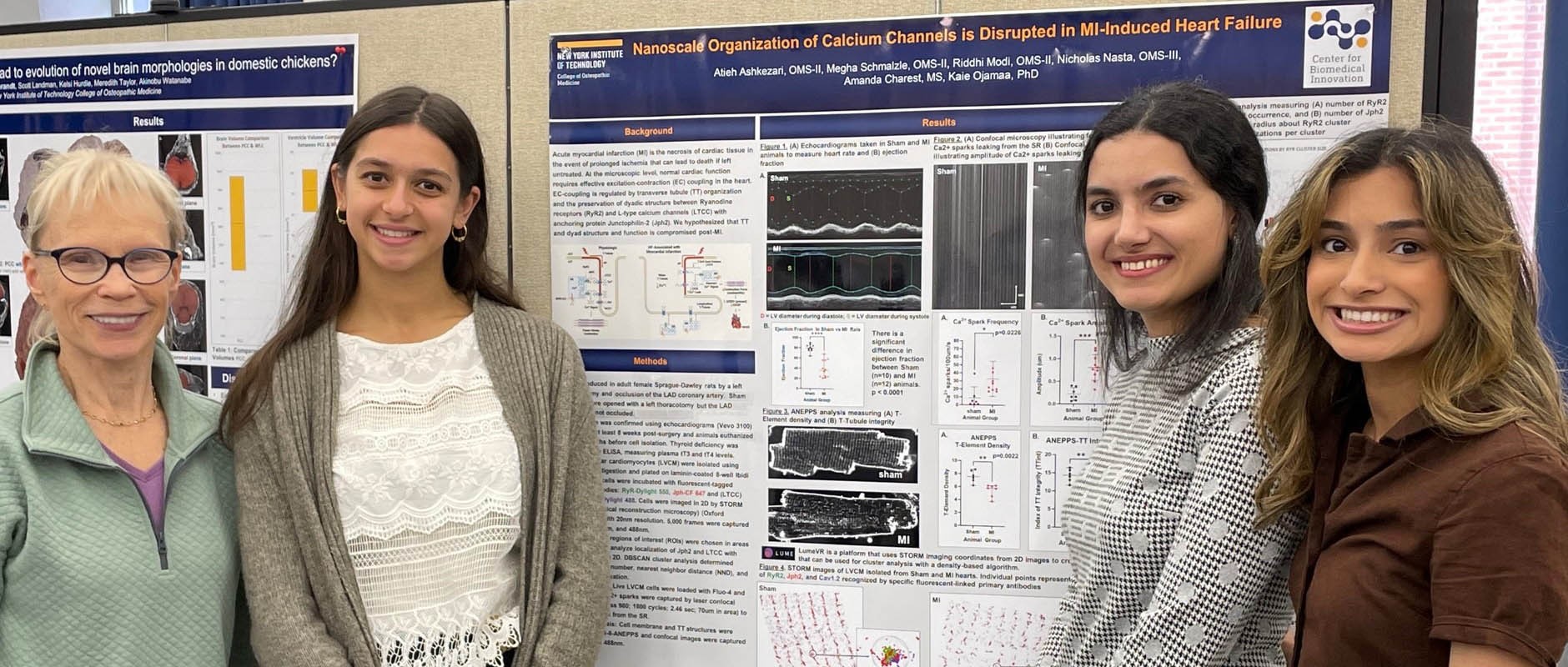
- Ashkezari A, Schmalzle M, Charest A, Kumar S, Modi R, Nasta N, Bertolini A, Saba A, Cifani P, Zhang Y, Gerdes AM, Stout RF, Ojamaa K. Super-Resolution 3D Imaging Reveals Disarray of Dyadic Calcium Ion Channels in Failing Hearts Expressing Low Thyroid Hormone Function. Int J Mol Sci. 2026 Jun 21;27(12):5601. doi: 10.3390/ijms27125601.
- Charest A, Nasta N, Siddiqui S, Menkes S, Thomas A, Saad D, Forman J, Huang X, Sison CP, Gerdes AM, Stout RF, Ojamaa K. Nanoscale organization of cardiac calcium channels is dependent on thyroid hormone status. Am J Physiol Heart Circ Physiol. 2024 Oct 4. doi: 10.1152. PMID: 39365674
- Gilani N, Wang K, Muncan A, Peter J, An S, Bhatti S, Pandya K, Zhang Y, Tang YD, Gerdes AM, Stout RF, Ojamaa K. Triiodothyronine maintains cardiac transverse-tubule structure and function. J Mol Cell Cardiol. 2021 Jun 24;160:1–14
- Wang K, Ojamaa K, Samuels A, Gilani N, Zhang K, An S, Zhang Y, Tang YD, Askari B, Gerdes AM. BNP as a New Biomarker of Cardiac Thyroid Hormone Function. Front Physiol. 2020 Jul 9;11:729
- An S, Gilani N, Huang Y, Muncan A, Zhang Y, Tang YD, Gerdes AM, Ojamaa K. Adverse transverse-tubule remodeling in a rat model of heart failure is attenuated with low-dose triiodothyronine treatment. Molecular Medicine 2019 Dec 6;25(1):53. doi: 10.11863
- Ojamaa K, Carrillo-Sepulveda MA. Thyroid hormone signaling mechanisms in the heart and vasculature. Thyroid hormones and Heart, 2nd Edition, Springer. 2019
- Mavropoulos SA, Khan NS, Levy ACJ, Faliks BT, Sison CP, Pavlov VA, Zhang Y, Ojamaa K. Nicotinic acetylcholine receptor-mediated protection of the rat heart exposed to ischemia reperfusion. Molecular Medicine 23:120–133, 2017
- McPhillips L, Kholwadwala D, Sison CP, Gruber D, Ojamaa K. A novel brain injury biomarker correlates with cyanosis in infants with congenital heart disease. Pediatric Cardiology 40(3):546–553, 2018
- Outstanding Faculty Member 2019, NYIT College of Osteopathic Medicine Student Government Association
- Research Training Awards, 2014, 2016
- Award for Educational Advancement, 2015
- Faculty Mentorship Award, 2012
- American Heart Association Rock Star of Research Award, 2011
- NIH Career Development Award, 1999–2004
- Case-Based Learning
- Academic Medicine Scholars’ Program
- DO/Ph.D. Program