Personal Experience Fuels Startup Idea
When Chigozie (Henry) Umeaku left his home in Nigeria to pursue a bachelor’s degree in mechanical engineering at New York Tech, he was required to obtain an F-1 student visa—nothing unusual for an international student—but personal experience demonstrated how convoluted the process can be. It inspired him to create a solution.

During fall 2025, Umeaku kept busy as an Entrepreneurship and Technology Innovation Center (ETIC) mechanical engineering intern, Tech Threads manager, and Long Island Student Government Association executive vice president—roles he maintained through the spring, as well. However, none compares to the entrepreneurial journey he embarked on in the class, NESTS: Necessary Eleven Steps to Tech Startup.
This experiential learning course teaches young entrepreneurs how to navigate the complexities of launching and managing a startup. At the end of the semester, students attended the NESTS Fly-Off event at the Innovation and Entrepreneurship Academy’s Startup Tech Central and presented their startups to a panel of judges from across Long Island’s tech industry.
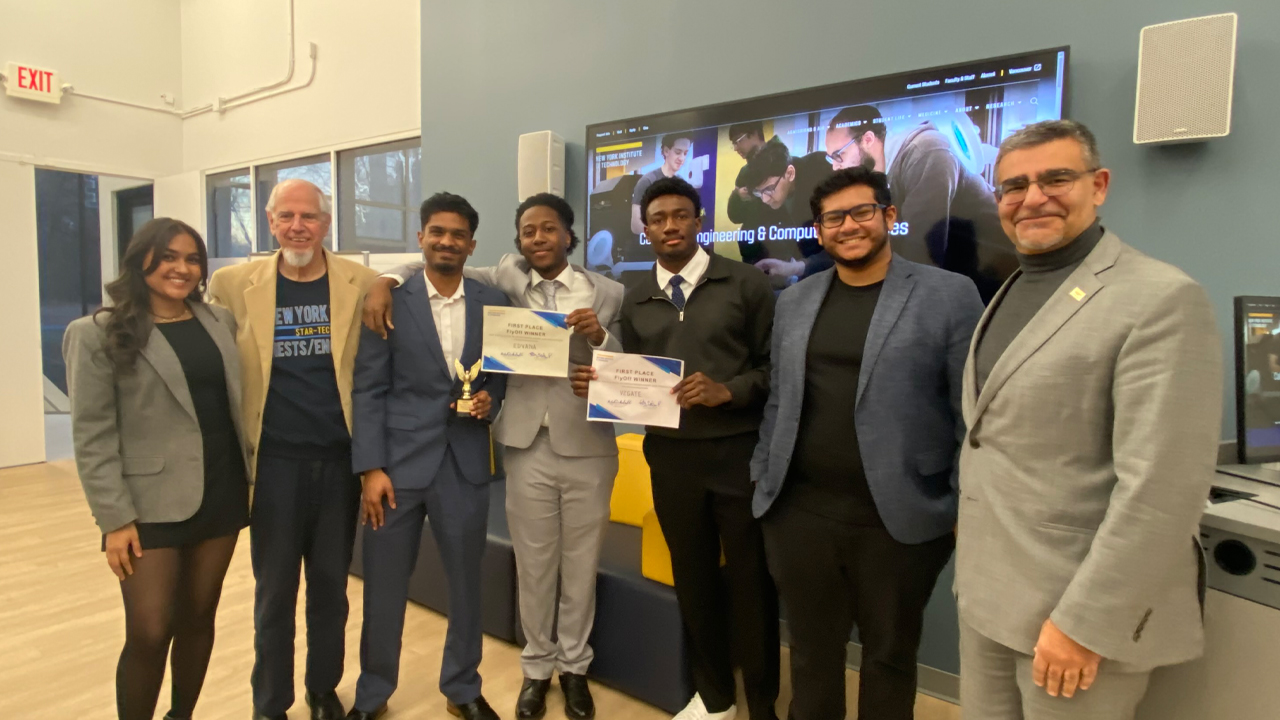
Umeaku introduced his company, VZgate, a trust-layer marketplace that connects prospective international students with verified study-abroad service providers through structured service milestones and transparent payment workflows. Along with his peers from Edvana, a classroom engagement tool, Umeaku received first place for his start-up at the Fly-Off last December. He then took first place in April at the New York Business Plan Competition’s regional level at Farmingdale State College.
“VZgate regulates this very unregulated space,” Umeaku explains. “The main goal is stopping scams in the student visa sector and properly connecting students with consultants.”
After doing his research, Umeaku discovered that he was not the only person who struggled to obtain a student visa efficiently. He found statistics detailing how out of the millions of students who study abroad every year, a staggering amount lose money to fraudulent student visa agents.
To combat this, VZgate acts as a structured marketplace between vendors and students. Milestone tracking includes services like an initial consultation, document preparation, application submission, interview prep, and post-approval support. Each milestone is assigned a monetary value and is broken down so each party knows exactly what to expect. The student’s payment is processed through the platform’s payment workflow, with vendor payouts tied to milestone review and student approval. Should the student raise dissatisfaction with a milestone, VZgate will mediate to ensure a fair outcome.
“There are a lot of complicated steps for prospective international students,” Umeaku says. “We make sure that vendors are legitimate and authorized to provide their service. This way, we have a way to hold them accountable if they don’t follow through.”
Umeaku is optimistic for his startup’s future success and feels confident that VZgate will be ready for a hard launch by fall 2026. He already has one vendor and 3,000 students registered to the online service’s backend, with 250 paid orders for an informational session. Ideally, he hopes to launch an app, expand into visa services beyond just students, and secure a multimillion-dollar valuation within the next few years.
Until then, Umeaku keeps his skills sharp in the ETIC. But even with a major in mechanical engineering and a minor in technology entrepreneurship, he still has his limits. Umeaku is steadily building his VZgate team to keep operations running smoothly and looks forward to onboarding some of his peers. This summer, he aims to perfect everything behind the scenes—an initiative he’s dubbed Software 2.0.
He is prepared for success, but Umeaku remains humble. Should his company not take off in the way he expects, he aspires to a career in hardware engineering. He might even pursue a master’s degree in mechanical engineering. Regardless, the lessons he’s learned along the way are invaluable.
“I discovered that I can learn anything, and I can push through to get things done,” he says. “What excites me the most is how great and how big things could be in the future. I can help my country, Nigeria, with what I do.”
More News

My Co-op Gig: Asghar Kazmi
Computer science student Asghar Kazmi worked for five months at GE Appliances—an experience he says aligned perfectly with his career goals.
New York Tech To Be Ranked Among National Universities
For the 2027 U.S. News & World Report annual rankings, New York Tech will be included in a new ranking category—National Universities.
Convocation 2026: Success in a Time of Change
At the annual faculty and staff convocation, New York Tech President Jerry Balentine reflected on the accomplishments over the past year and presented his vision for the future.
Robust Research
New York Tech’s commitment to research paves the way for important and groundbreaking work. Meet three Ph.D. students whose work may improve disaster response, recovery after muscle and bone injuries, and anticancer therapies.

A Passion for Games, a Vision for Business
College of Engineering and Computing Sciences student Cody Ortiz helps his father run a florist shop, an endeavor that inspired him to become an entrepreneur, too.

The Problem Solvers
Meet four alumni who use their lived experiences as inspiration for entrepreneurship.