Turning Adversity Into Discovery
When mechanical engineering graduate student Bryan Shivram (B.S. ’23) had his research published in Scientific Reports, it was more than an academic achievement—it represented an important milestone in his own healing journey.
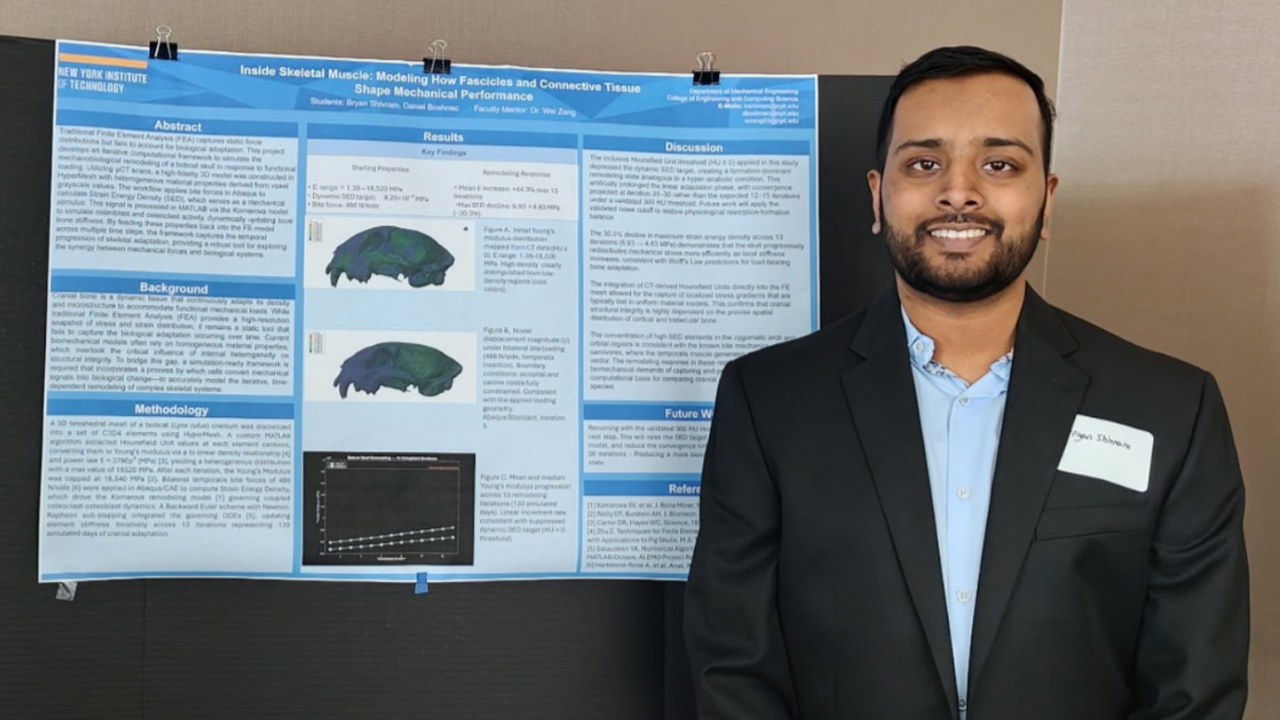
Shivram’s published research explores the use of computational modeling to simulate how bones change after physical trauma, treatment, or repeated stress, a process he now understands on a deep personal level.
In fall 2019, Shivram was about to embark on his freshman year at New York Tech when his life took an unexpected turn. He experienced a seizure and was diagnosed with a tumor in the left hemisphere of his brain. The Valley Stream student viewed the subsequent surgeries, complications, and long hospital stays as only a temporary setback in his educational journey, quickly resuming his studies a year later.
In 2021, another seizure caused him to fracture his jaw and sustain microfractures extending into his skull, requiring extensive bone restructuring. Combined with the openings made in his skull during brain surgeries, the mechanical engineering student became intimately familiar with bone fractures and healing.
“Who knew fracture mechanics would be a major part of my life?” Shivram says.
In and out of the hospital, Shivram always found ways to expand his knowledge, even having detailed discussions about skull and bone anatomy with his oral maxillofacial surgeon.
“I was very intrigued about the whole situation. Not only am I very into mechanical engineering, but I was also very into biomechanics,” he says. “That’s actually why I chose mechanical engineering; it’s a very broad topic.”
In early 2026, Shivram says he “instantly latched onto” a research opportunity to study bone remodeling through finite element analysis under the mentorship of Wei Zeng, Ph.D., assistant professor of mechanical engineering.
The connection was made even more personal when the bobcat skull used in the research coincidentally had fractures across the same section of skull where he had experienced his own injuries.
The structure of his research allowed Shivram to work both independently and collaboratively, an opportunity he credits with helping him grow personally and academically.
“The support I received from Dr. Wei Zeng was phenomenal. He helped me every single step of the way through this,” shares Shivram. “I was not only able to get help, but I was able to work independently at the same time.”
“Given everything he has been through, completing the research and publishing the paper in just six months was a great achievement,” Zeng says. “Bryan is highly self-motivated, knows what needs to be done, and works diligently. He often emails me late at night to share research updates. His dedication and perseverance are truly impressive.”
Findings from the report demonstrate how finite element computer modeling can help researchers better understand how bones change and rebuild over time. Shivram says the approach could eventually help model how fractures respond to everyday movement or how prosthetics affect the body over time. The research technique also goes beyond mechanical modeling by incorporating cellular processes to provide a more comprehensive picture of how bones respond to stress and injury.
“It’s all about seeing the next step,” he explains.
As he wraps up his studies at New York Tech, Shivram continues his bone remodeling research and one day hopes to pursue research using finite element analysis to study the ocular system—inspired by his own vision complications.
With wide-ranging interests from literature and history to physics and creative writing, Shivram has never been deterred from exploring new opportunities. His mechanical engineering education has given him the foundation to turn his curiosity into research—and continue exploring wherever it may lead.
The research was supported in part by the Institutional Support of Research and Creativity (ISRC) program, funded by New York Institute of Technology and the U.S. National Science Foundation.
More News
First-Gen Entrepreneur
Computer science student Rida Rahim has an impressive résumé of projects, and is only getting started.
A Passion for Games, a Vision for Business
College of Engineering and Computing Sciences student Cody Ortiz helps his father run a florist shop, an endeavor that inspired him to become an entrepreneur, too.
Building Machines…and a Future
Mechanical engineering student Anthony Vazquez Rivas aspires to a career in HVAC, but it’s the projects he’s worked on along the way at New York Tech that inspired him to decide on the specialty.

When Numbers Become Shapes
Ricardo Cabret (M.S. ’14), who studied computer science in the College of Engineering and Computing Sciences, transforms digital code into physical art.
Longtime Economist Finds His Way Into Nuclear Energy Sector
Dario Martinez (M.S. ’25) has spent most of his professional career as an economist, and over the past three years, the energy management alumnus has become one of the voices shaping the conversation around Puerto Rico’s energy grid.
SGA President Paves the Way for Current and Future Students
Student Government Association (SGA) President Yael Mendez Saavedra came to New York Tech because of its reputation and ended up enjoying his extracurricular leadership roles just as much as his studies.