An Out-of-This-World Experience
Some New York Tech students have their sights set on an extraterrestrial-focused career, but for now, they are creating NASA-patented technology for earthbound applications.
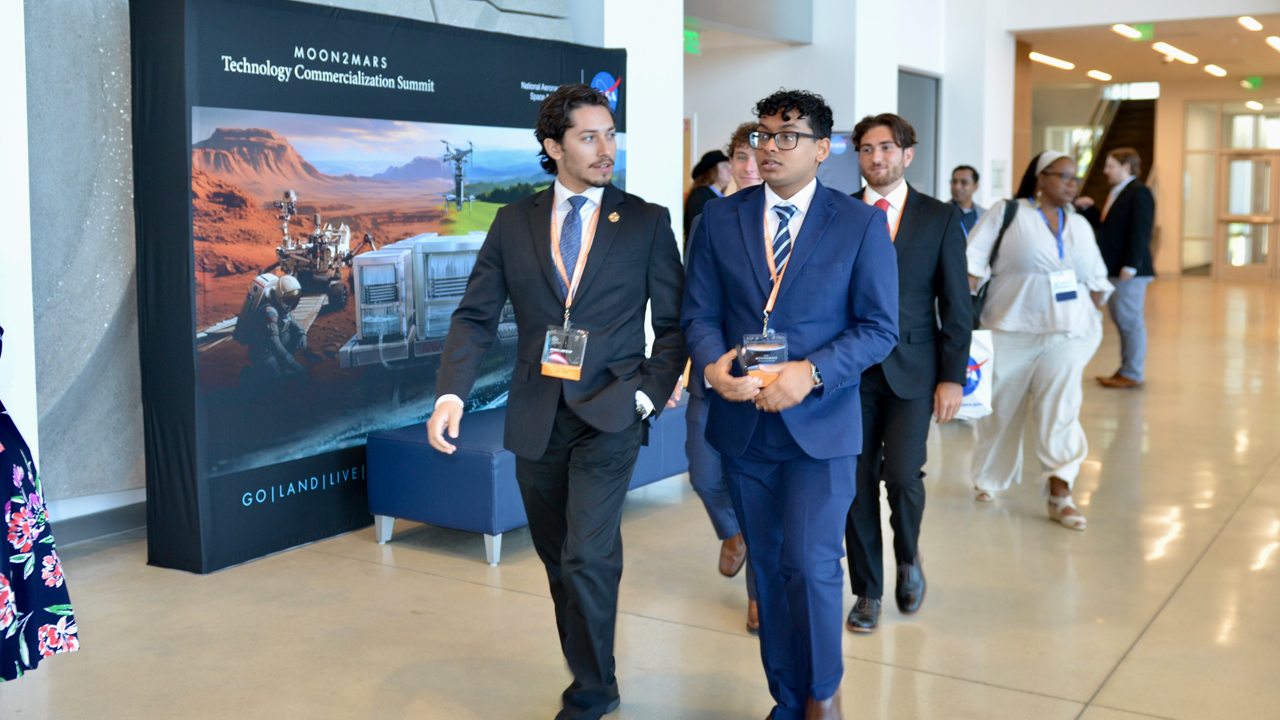
Five student engineers at New York Tech’s Entrepreneurship and Technology Innovation Center (ETIC) and one former ETIC student traveled nearly a thousand miles in September to present 14 of their NASA-patented prototype technologies at the Moon to Mars Technology Commercialization Summit at the U.S. Space & Rocket Center in Huntsville, Ala. Produced by Stemcomm Ventures, a technology commercialization advisory firm based in Newport News, Va., the summit accomplished multiple goals: demonstrating working prototypes as use cases for NASA’s patented research, including the prototypes New York Tech builds for NASA’s Technology Transfer Expansion (T2X) office, as well as supporting entrepreneurs who want to license NASA-patented technology to build a business.
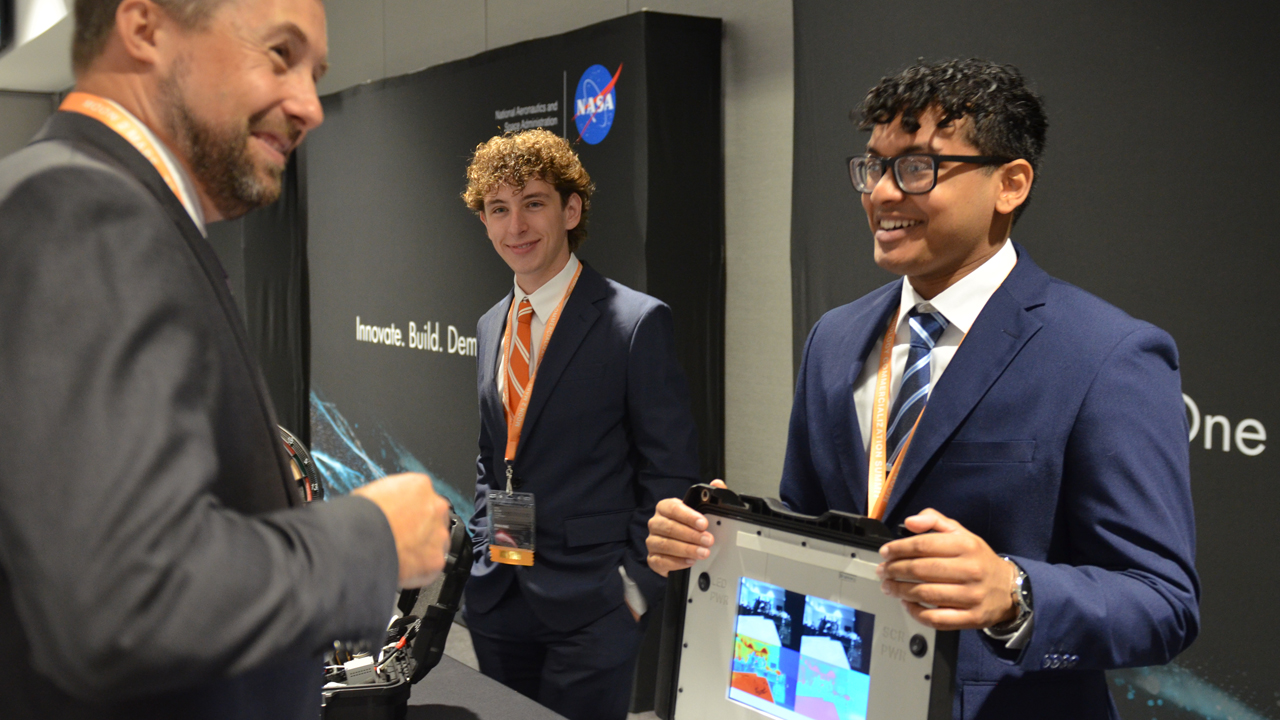
By putting these entrepreneurs in the same room with the ETIC student engineers who built the prototypes, the Moon to Mars Summit offered a valuable, hands-on experience for the students to present live demos to more than 150 summit attendees, showcasing their creativity and engineering talents and developing strong presentation skills in a fast-paced environment.
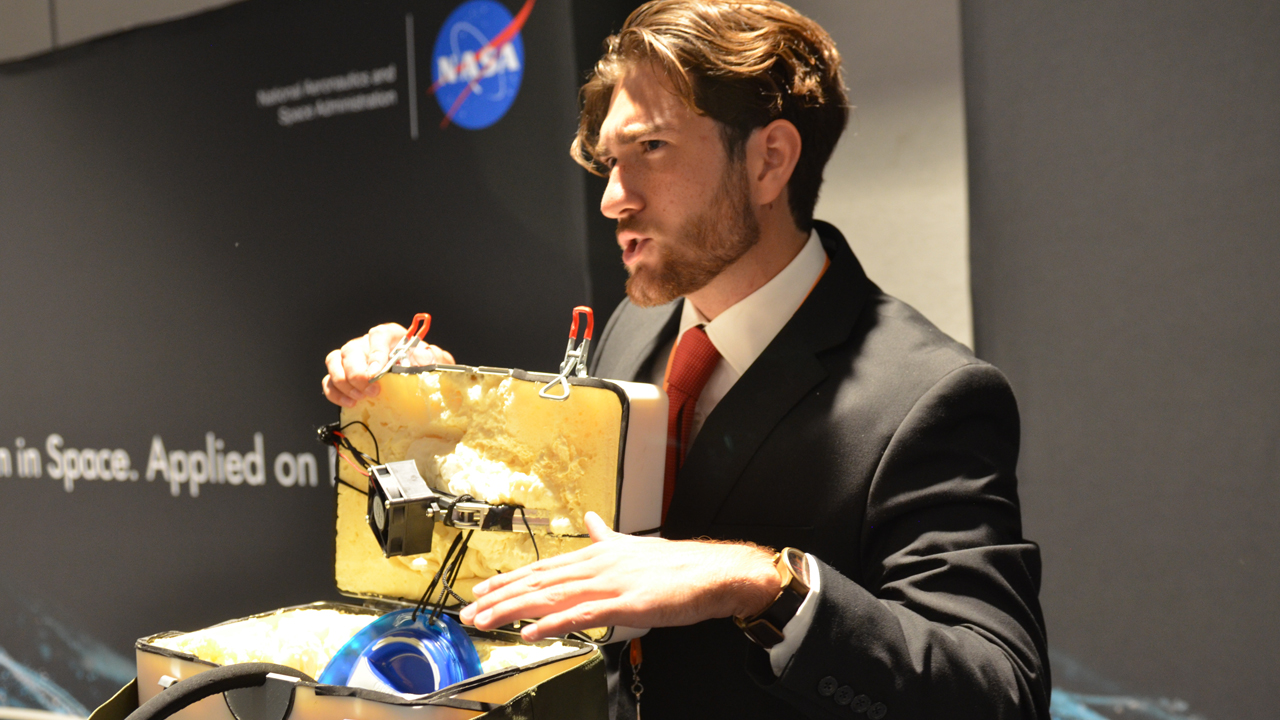
“We were learning to flow from one prototype to another, keeping the people you’re talking to interested in one but also tying it into another one,” says Logan Edwards, an electrical and computer engineering major and a project manager at the ETIC. “The entire prototype presentation was dynamic for each person who came in.”
And not only were the ETIC students showing entrepreneurs how the prototypes worked, but they could also pitch ideas for a startup to put the tech to real-world use.
“NASA’s T2X office benefits from the prototypes that we build at the ETIC at New York Tech by being able to demonstrate their patent claims in a functioning demo to potential licensees,” explains Assistant Dean and Director of the ETIC Michael Nizich, Ph.D., who noted New York Tech’s contract with T2X to build the prototypes has been ongoing since 2021. “The T2X office is tasked with licensing NASA’s patents, so they are demonstrating to companies that they can commercialize the product and create a profitable business from the technology.”
“A company can license the patent and make whatever they want,” Edwards says. “The point for us being there was to give them inspiration. We were showing off the capabilities of these patents—not just with words, but to show people, ‘Here it is, working.’ Also, we could give them ideas, not focused on specific prototypes, but more on the idea of the patent—trying to take a patent and turn it into something real.”
“I could ask what their business is,” says Ashwin Joseph, a computer science major and project manager at the ETIC, “and based on the overall idea of their business, I can mention use cases.”
As part of the summit, entrepreneurs from around the country had working sessions with coaches and talked to the student engineers about the technology’s capabilities. Then, the entrepreneurs competed in the Civil Space Shortfall Solution Challenge, a pitch competition across seven NASA technology tracks, presenting business models built on NASA-patented technology. “The Moon to Mars Summit gives founders direct exposure to NASA intellectual property, the inventors’ work, and the licensing pathway that turns federal research into operating companies. The New York Tech students made that pathway visible,” says Jeff Johnson, founder and chief executive officer of Stemcomm Ventures, which also produced NASA’s Assistive Technologies Startup Summit in December 2024, where several ETIC students presented assistive technology prototypes. “They walked in with working prototypes built from NASA patents and showed every founder in the room what a patent becomes when someone picks it up and builds.”
Preparing To Launch
The students spent months preparing for the Moon to Mars Summit. A major concern was getting the prototypes to Alabama in one piece. Because the prototypes had to be shipped to Huntsville, the students would have to prepare to repair any damage that might occur during transit.
The catch: They had to make repairs with materials they were able to carry with them on the airplane—no batteries, no liquids, and nothing that couldn’t fit in their suitcase.
“We had materials and tools, so we were prepared to repair things the day before the event,” Edwards says. “Seeing that most prototypes were working made it less stressful. But anything can happen during a live demo, and all of the prototypes are one-of-a-kind. So, after the event, we had to make sure it was all working and packed up properly for transport back to NASA.” Also, before the summit, the students had to consider who would present each prototype, and how—there were 14 prototypes and only six presenters. With dozens of companies attending the summit, the students had to be adept at fielding questions from many entrepreneurs at once.
“The students were expected to be professional,” Nizich says, “and they were fantastic.”
Presenting the Prototypes
The 14 prototypes chosen for demos at the summit had been created for NASA’s T2X office over the past five years as part of the contract with the ETIC. Each one had potential uses for space missions as well as applications on Earth.
For example, the Ruggedized Infrared Camera, which the student engineers designed to be nearly indestructible.
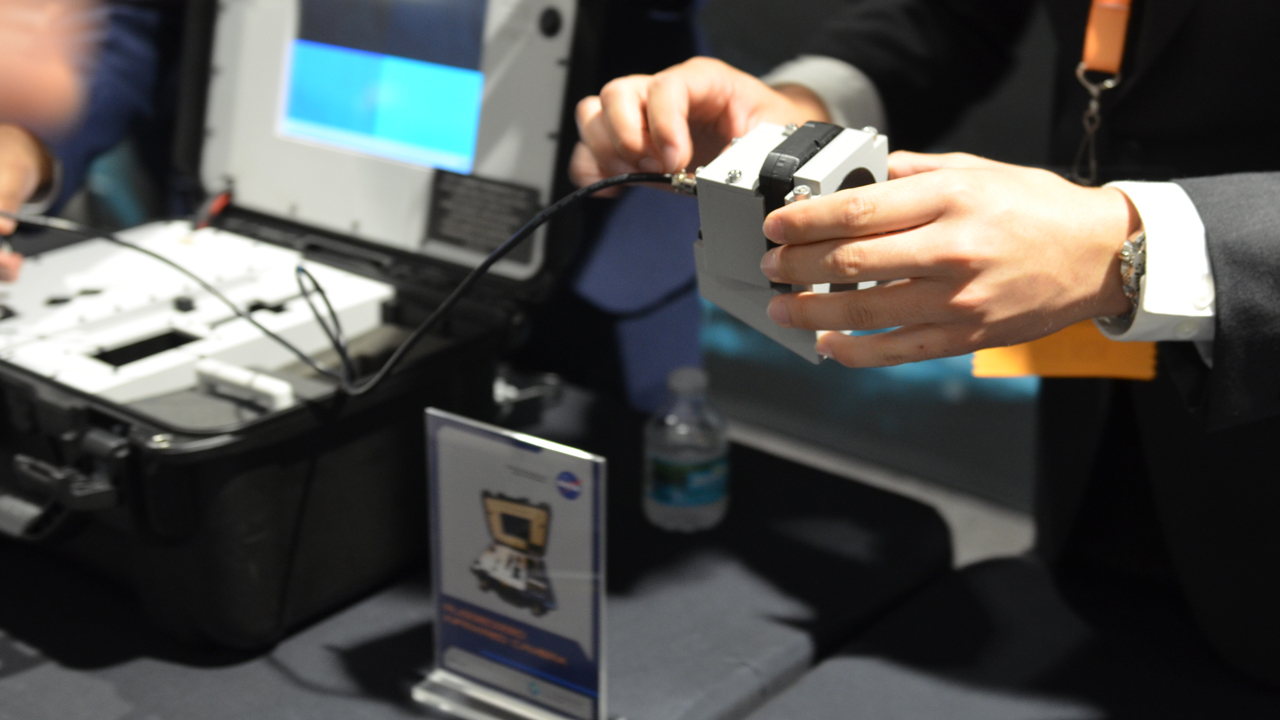
“The IR camera has numerous mechanisms inside to make it highly, highly durable,” Edwards says. “It’s meant to go into extreme environments and come out without a scratch.”
The camera has space implications, such as monitoring the temperature under a rocket thruster during a rocket launch, but it can be used in any extreme environment on Earth, too, such as in a war zone mounted on a military vehicle.
“The IR camera was one of the first projects I worked on as a software engineer and ETIC engineer, actually working on something that’s described in a patent by NASA,” Joseph says. “I created the graphical user interface, which has four different filters for different thermal readings.”
Among the summit attendees was Chase Wortman, president and chief executive officer of Outpost Technologies, a company that provides innovative technology solutions to government and commercial customers. Wortman was excited to see a working prototype of the IR camera at the summit, demonstrated by the engineers who built it. He has already licensed the NASA patent for real-world use.
Among the other prototypes was the RoboGlove. “The glove is designed to assist astronauts in space for a long duration of time,” Edwards explains, noting that the glove also has practical applications on Earth, such as for people with mobility challenges. “It automatically adjusts to the user’s grip and continues to hold the object for the user, which helps lower hand fatigue.”
Edwards was also in charge of presenting two other prototypes: the PUMA and the Freeze-Resistant Hydration System. The PUMA, or Portable Unit for Metabolic Analysis, is a device that can measure a person’s oxygen and carbon dioxide levels in real time, sending an alert if oxygen levels drop too low, before the person even notices a change. NASA’s research was originally developed to protect fighter jet pilots, but on the ground, the PUMA device could be used by physicians to assess a patient’s oxygen levels remotely.
Freeze Hydration, as the students call it, is designed to keep liquids in a liquid state even in extreme temperatures, which is essential in the freezing temperatures of space, but also useful for earthly activities. “Like climbing Mount Everest,” Edwards says. “You need water even at this low temperature, and Freeze Hydration keeps water as a liquid.”
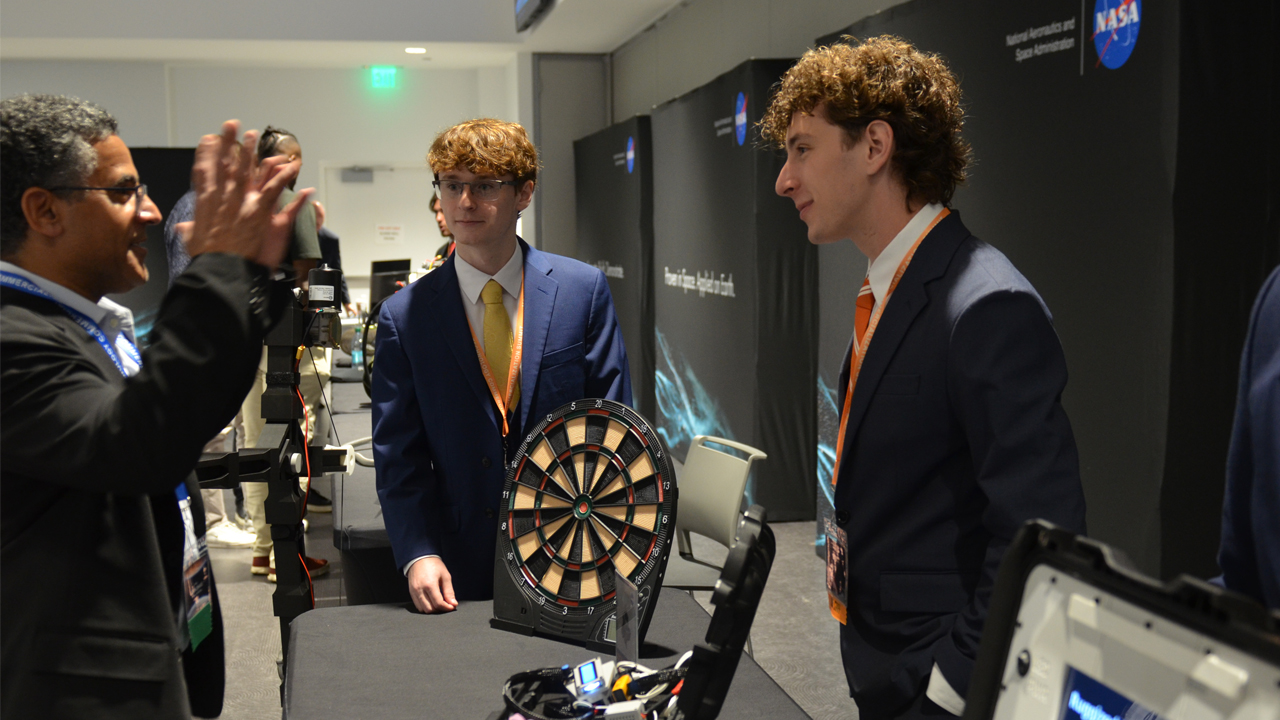
Although juggling three different prototypes and dozens of interested attendees kept him on his toes, Edwards gave demonstrations and answered questions expertly, thanks to presentation skills he honed when showcasing his work at other events, such as the College of Engineering and Computing Sciences Ingenium Awards.
“PUMA was on my left, and then I would transition to Freeze Hydration, and then I would ask if they were interested in the robotic glove,” says Edwards, who has worked at the ETIC for the past three years. “I mainly presented those three prototypes, but I also answered questions about other projects if another student was talking to other entrepreneurs.” Not only were the students representing New York Tech on the conference floor, but they also took the stage. Nizich and Derrick Chiu, the former ETIC student, spoke on the summit’s Founder and Leader Panel, moderated by Christie Funk, the entrepreneurial engagement manager at NASA Technology Transfer.
Preparing To Launch … a Career
“At the ETIC, I’ve learned how to manage a team, working with mechanical and computer science engineers with different capabilities,” says Edwards, who dreams of following a career path in the space industry. He has already founded his own company, Edwards Technology Solutions, to contract with businesses outside the ETIC. “I’ve had to think about how my designs were going to interact with what they were doing, which goes directly into a career. This is not waiting until school is over. It’s happening right now.”
The summit experience for these six New York Tech students—Edwards, Joseph, Chiu, Ryan King, Russel Wetzler, and Tyler Hradek—bolsters their résumés in preparation for entering the job market after graduation.
“I’ve been with the ETIC since I started college,” says Joseph, who hopes to work as an AI engineer or data engineer after graduation. “Not only has it helped me grow as an engineer, but the client-facing experience it’s giving me is priceless.” “At the ETIC, I’ve learned how to manage a team, working with mechanical and computer science engineers with different capabilities,” says Edwards, who dreams of following a career path in the space industry. He has already founded his own company, Edwards Technology Solutions, to contract with businesses outside the ETIC. “I’ve had to think about how my designs were going to interact with what they were doing, which goes directly into a career. This is not waiting until school is over. It’s happening right now.”
By Ashley Festa
More News
Turning Adversity Into Discovery
Learn about mechanical engineering graduate student Bryan Shivram’s (B.S. ’23) journey into biomechanics research.

First-Gen Entrepreneur
Computer science student Rida Rahim has an impressive résumé of projects, and is only getting started.
The Domino Effect
New York Tech’s Research Experiences for Undergraduates program has spent more than a decade turning summer research opportunities into lasting careers, helping build the university’s research reputation along the way.

My Co-op Gig: Asghar Kazmi
Computer science student Asghar Kazmi worked for five months at GE Appliances—an experience he says aligned perfectly with his career goals.
New York Tech To Be Ranked Among National Universities
For the 2027 U.S. News & World Report annual rankings, New York Tech will be included in a new ranking category—National Universities.
Convocation 2026: Success in a Time of Change
At the annual faculty and staff convocation, New York Tech President Jerry Balentine reflected on the accomplishments over the past year and presented his vision for the future.