Reversing Bone Loss After Spinal Cord Injury
Findings from a new study led by Research Associate Professor of Biological and Chemical Sciences Hesham Tawfeek, MBBCh, could help reverse severe bone loss caused by spinal cord injury (SCI).
SCI is a major trauma commonly caused by motor vehicle accidents, falls, stab wounds, gunshots, and explosions. One well-known instance of SCI is that of actor Christopher Reeve, who became paralyzed after sustaining a horseback riding injury. Many individuals with SCI experience lower limb paralysis, causing loss of normal weight-bearing and voluntary muscle contractions that occur during walking and are critical for bone health. As a result, individuals with SCI may lose up to 41 percent of bone mass within the first year, much more than the bone loss caused by prolonged bed rest or aging.
To further complicate matters, SCI bone loss does not respond to current therapies, increasing the risk of fractures even from minor trauma. In fact, people with SCI are up to 100 times more likely to sustain a lower limb fracture than the general population. Restoring bone structure would allow individuals to safely use walking aids and exoskeletal devices, improving their independence and quality of life.
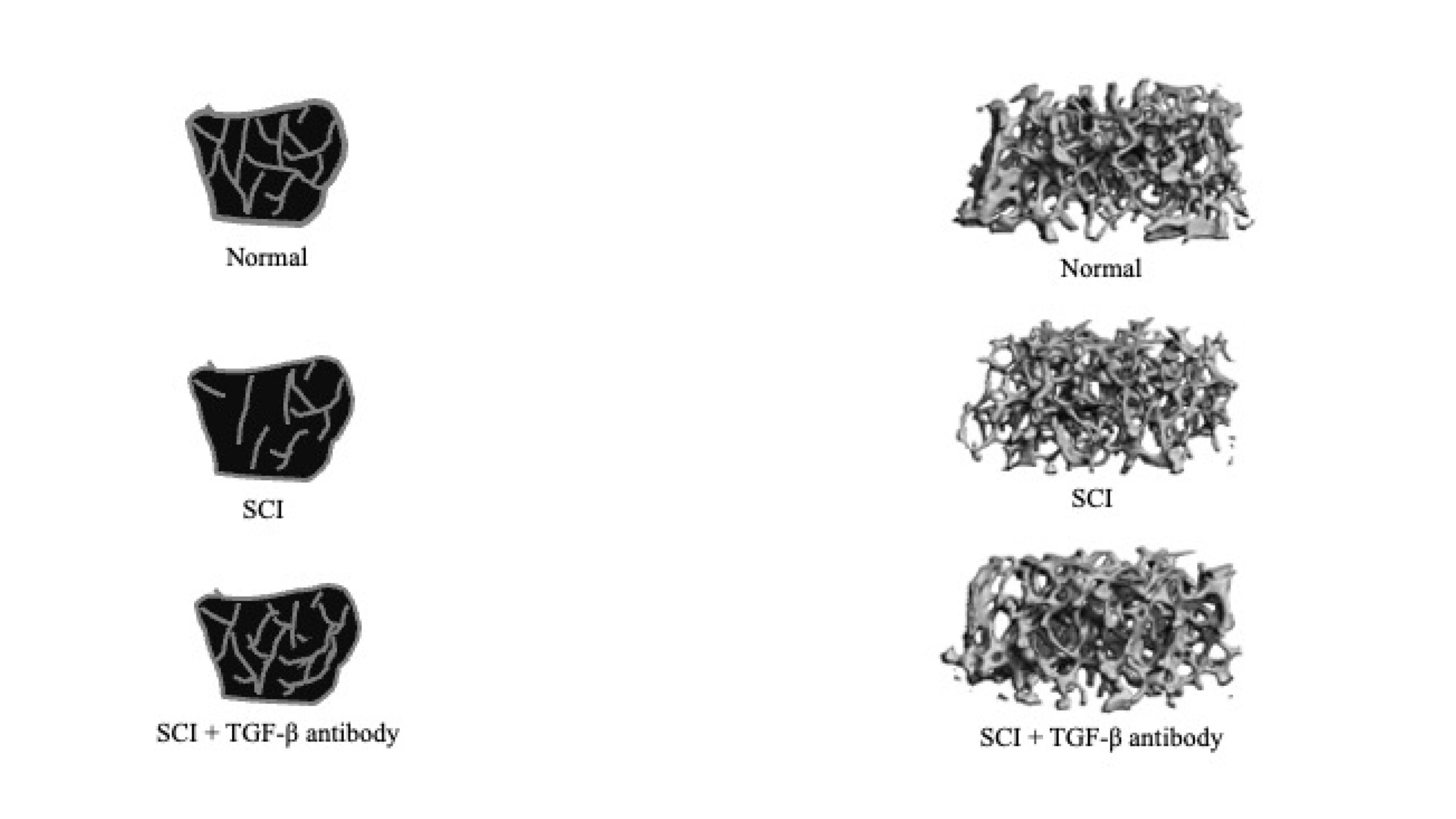
As published in FASEB, the official journal of the Federation of American Societies for Experimental Biology, Tawfeek and a team of scientists have successfully reversed severe SCI-induced bone loss. In a mouse model of SCI, the researchers administered an antibody that specifically targets and inhibits the signaling of a protein called transforming growth factor-β, or TGF-β. Normal levels of TGF-β’s signals help cells communicate, but if they become excessive, they negatively affect bone-building processes. “Sure enough, when SCI was present, we saw increased levels of TGF-β, which likely caused detrimental effects on the skeleton,” notes Tawfeek.
Using a high-resolution 3-D X-ray imaging technique called micro-computed tomography, the researchers compared bone structure between SCI animals that received the TGF-β-targeted antibody and a group that received a non-targeting (control) antibody. Remarkably, after only five weeks, those treated with the TGF-β–targeted antibody showed complete restoration of trabecular bone, the spongy compartment at the ends of long bones, which is most impacted after SCI.
The findings build a strong case for testing TGF-β-targeted antibody therapies in humans with bone loss after paralysis. As a next step, the researchers aim to conduct clinical trials that test the efficacy of a human TGF-β antibody equivalent called “fresolimumab.” The investigational drug has been tested for the treatment of certain cancers in humans with acceptable safety and may also offer a promising solution for reversing bone damage caused by SCI and other conditions causing reduced mobility.
“Our findings are expected to promote clinical trials to test the efficacy of fresolimumab in treating bone loss and preventing fractures after SCI. If this drug demonstrates a similar effectiveness in humans as the antibody treatment used in our animal study, it will be a true breakthrough in fighting debilitating and resistant SCI-induced bone loss,” Tawfeek says.
Distinguished Professor and bone biologist Michael Hadjiargyrou, Ph.D., and former Research Assistant Margo Button are also listed as study co-authors. Collaborators from outside New York Tech include Jeffry S. Nyman, Ph.D., of Vanderbilt University Medical Center and William A. Bauman, M.D., of the Icahn School of Medicine at Mount Sinai.
More News
Bringing Literature to Life
Professor of Humanities and New Your Tech’s second Distinguished Professor Jonathan Ezra Goldman dispels myths of the 1920s—and the myths students tell themselves.
New York Tech To Be Ranked Among National Universities
For the 2027 U.S. News & World Report annual rankings, New York Tech will be included in a new ranking category—National Universities.
Exploring How AI Tools Can Improve Lung Cancer Detection
Research by Assistant Professor Robert Alexander, Ph.D., and student Talia Lilikakis assesses how AI tools can most effectively alert radiologists of the possible presence of a nodule.
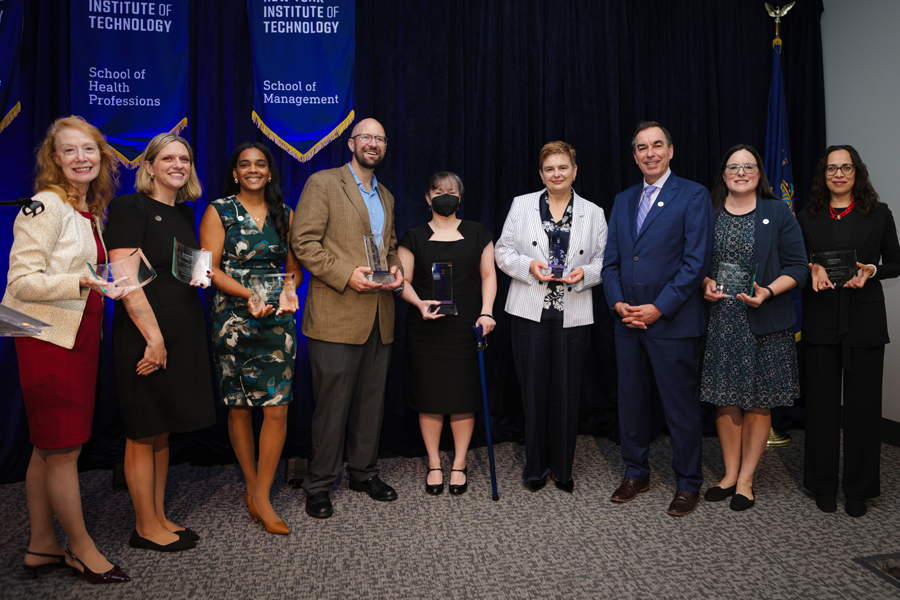
Convocation 2026: Success in a Time of Change
At the annual faculty and staff convocation, New York Tech President Jerry Balentine reflected on the accomplishments over the past year and presented his vision for the future.
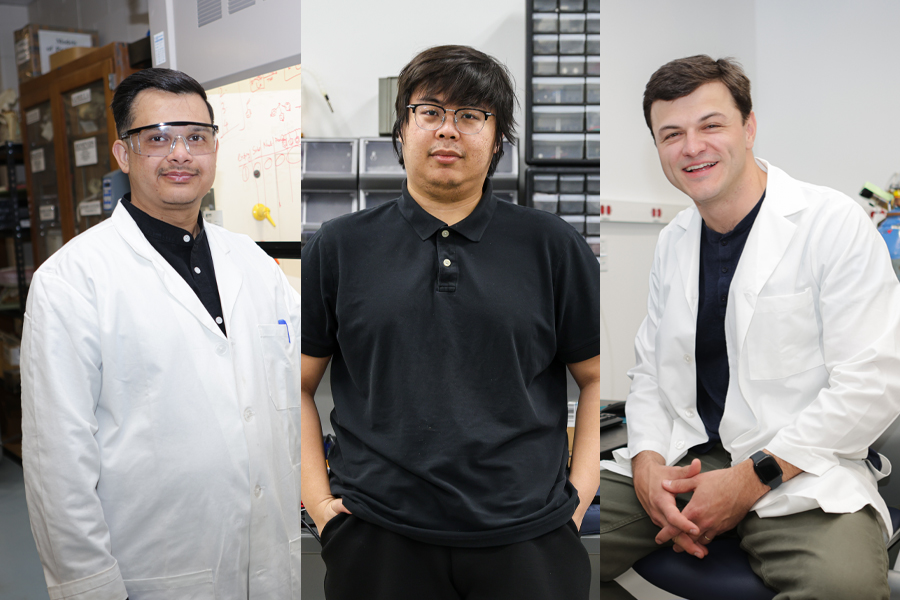
Robust Research
New York Tech’s commitment to research paves the way for important and groundbreaking work. Meet three Ph.D. students whose work may improve disaster response, recovery after muscle and bone injuries, and anticancer therapies.
Helping Children Manage Back-to-School Anxiety
Cognitive neuroscientist Robert Alexander, Ph.D., assistant professor of counseling and wellness, reminds parents to know the signs of potential anxiety in children as the new school year approaches.