Examining the Role of Inequality in Human Migration
For more than 100 years, researchers have strived to develop mathematical models that predict patterns of human migration and commuting. But the models have serious shortcomings, particularly by only accounting for differences in population size between cities and not factors such as whether areas are affected by conflict or natural disaster.
Alain Boldini, Ph.D., remembers learning about these limitations as a postdoctoral (postdoc) researcher at New York University (NYU) while discussing climate change mitigation projects.
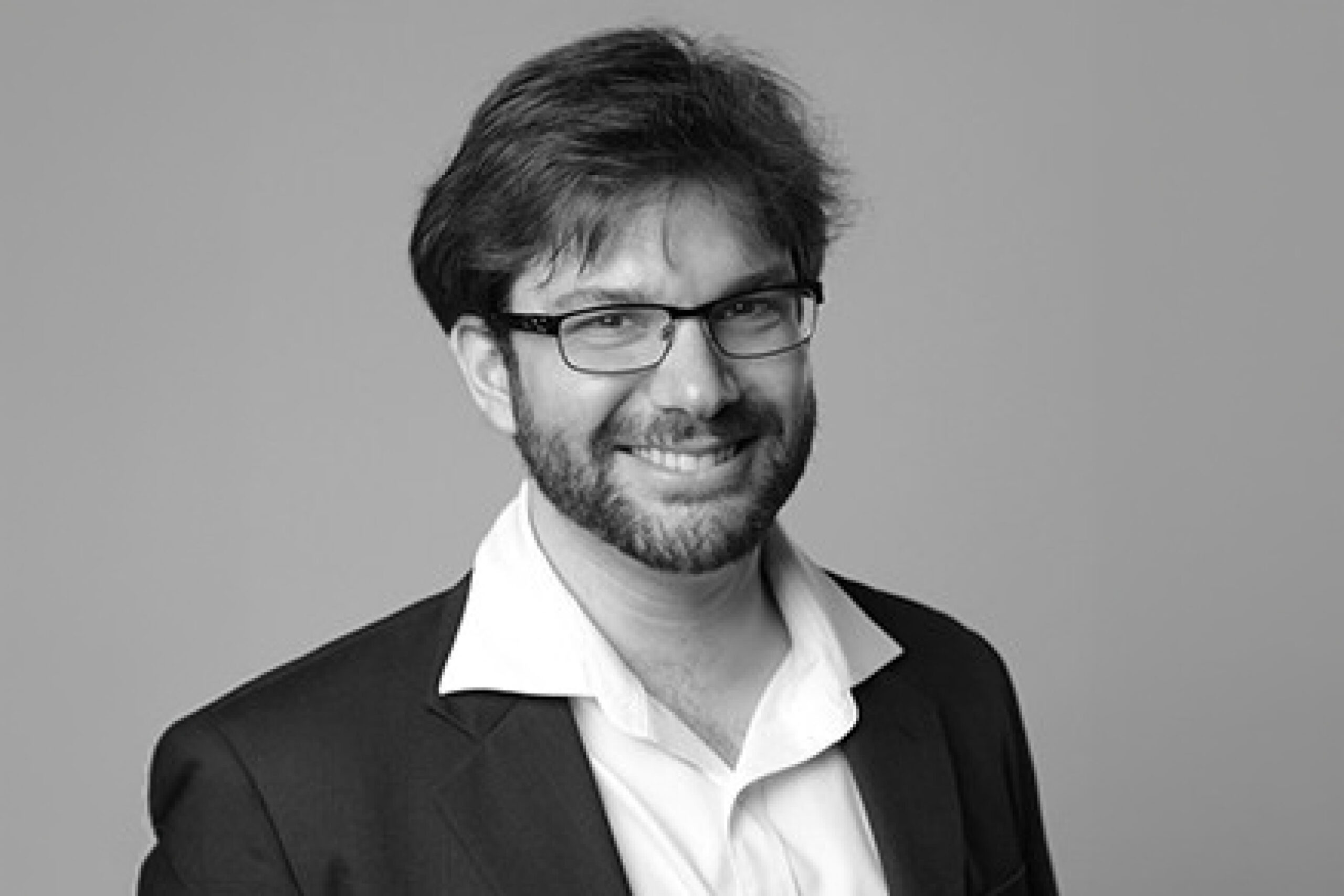
“The main issue with these models that just use population size is that they don’t work as well when you have extreme conditions, and those are a big reason that people migrate,” says Boldini, who joined New York Tech in the fall of 2023 as an assistant professor of mechanical engineering. One stark example is that, although a common model correctly predicted that people tend to migrate into New Orleans from less populous surrounding towns, it continued to suggest an influx into the city after Hurricane Katrina and its devastating flooding in 2005 (in reality, the city’s population shrank by half).
“We need models to help us understand where people will migrate in the coming years, in response to sea level rise and other events, so governments can invest in infrastructure to prepare and build housing, roads, everything,” Boldini says.
To address this need, Boldini applied his expertise in building models that represent complex systems—often based on physics concepts and tested against real-world data sets—to the problem of human mobility. In work that began during his postdoc at NYU, he and his collaborators developed two models: one for estimating commuting patterns between counties and within the continental United States, and the other for estimating migration patterns between regions of South Sudan.
In tests, the models vastly improved upon the ability to capture mobility, particularly for people in South Sudan who were fleeing conflict and flooding. He recently completed the project and is the lead author on the study, which was published in PNAS Nexus, a preeminent journal for innovative, interdisciplinary research.
Capturing the Effects of Conflict, Natural Disasters, and Economic Factors
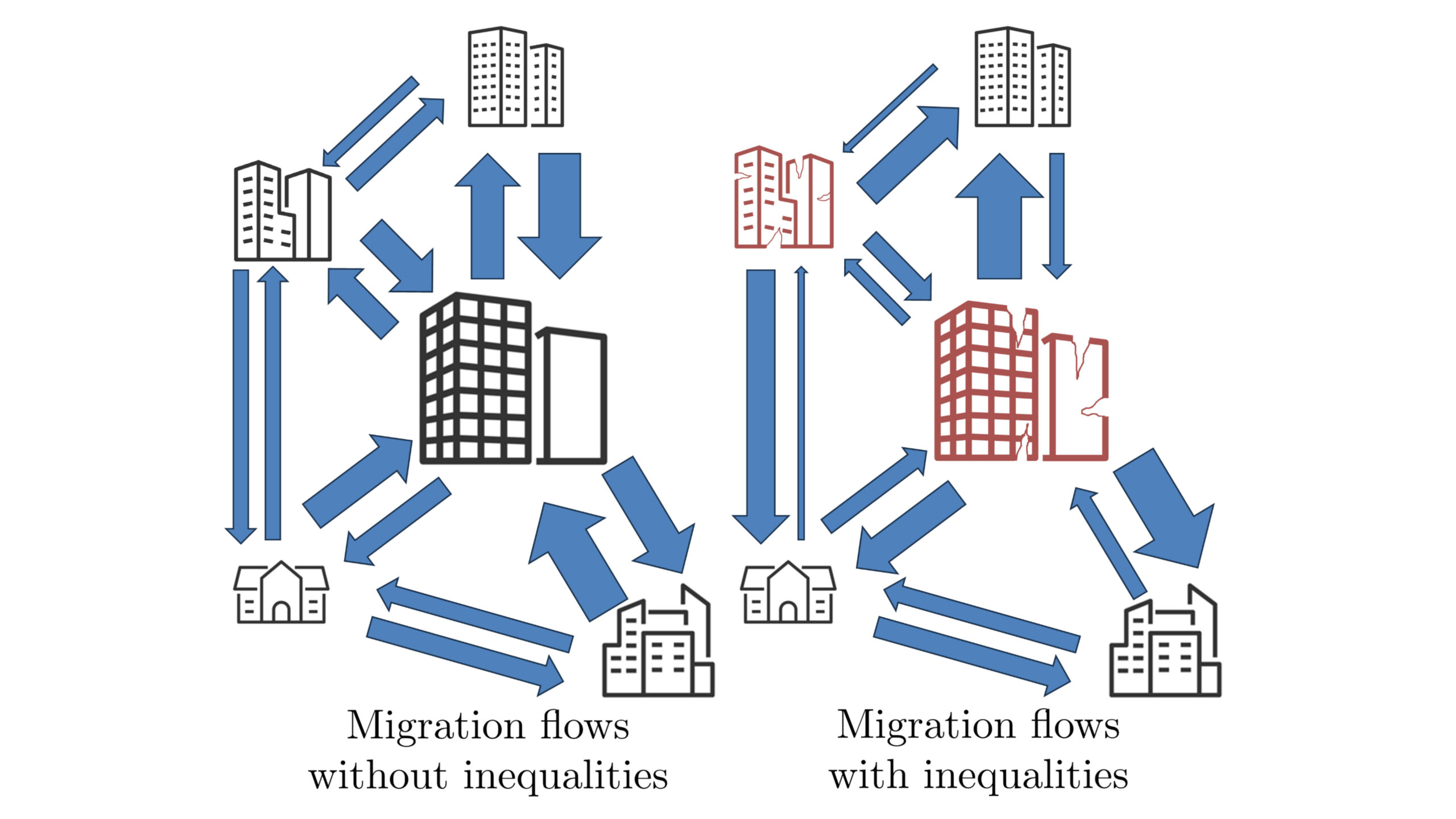
The leading human mobility model, developed nearly 15 years ago, is called the radiation model. As Boldini explains, it is based on physics models that describe the movement of particles, and assumes that people move like particles, and migrate from one city to the closest nearby city because it offers better opportunities; it also assumes that more populous cities have better opportunities in terms of jobs and infrastructure. It works well enough under normal conditions, absent extreme events, he adds.
Although researchers have been aware that the radiation model comes up short in predicting migration in response to natural disasters or conflicts, they have been hampered in building better models because of lack of data sets to test them against. During extreme events, the focus of governments and organizations is less on collecting data about how many residents are fleeing and to where, and more on preparing and protecting communities, Boldini says.
Boldini’s team got a break when one of their collaborators, at the University of Naples Federico II in Italy, compiled publicly available records of South Sudanese migration from the United Nations International Organization for Migration into a format that was usable for developing mathematical models. They focused on the years from 2020 to 2021, which followed the country’s bloody civil war (2013-2018) and major flooding (2019).
With the data set in hand, the team went to work modifying the radiation model to include two factors that they assumed played the biggest roles in the migration of people in South Sudan: conflict, represented by the number of casualties per capita, and flooding. They found that their model did a significantly better job capturing migration patterns than the standard radiation model—and that flooding or flooding plus conflict had a greater impact on migration than conflict alone, possibly because flooding in the country, where most people are subsistence farmers, was more recent than the civil war.
Closer to home, Boldini and his colleagues explored U.S. patterns of commuting for work, both short and long distances. For this scenario, the team modified the radiation model to encompass several economic measures for the origin and destination counties: unemployment rate, index of income inequality, percentage of people living below the federal poverty line, and ratio between median rent and median household income. They found that their model performed better than the standard radiation model at estimating actual commuting patterns, taken from the 2011-2015 U.S. Census Bureau data, especially for long-distance trips, such as California to Florida and Massachusetts to New York City.
“The main advantage of our models is that they allow us to do a better job of predicting trends. We probably can’t use them to predict the exact number of people moving, unless we make the models more complex, but we can say which counties will get the largest influx of people through migration or commuting,” Boldini says. The models for South Sudan migration and U.S. commuting can be adapted to other areas, with factors that are likely to affect migration there, he adds.
Capturing the Effects of Conflict, Natural Disasters, and Economic Factors
Since starting at New York Tech, Boldini has continued to stretch the applications of his mathematical models to explore all manner of research questions. “Translating similar mathematical frameworks to different types of systems is the fun part,” he says.
Boldini developed a model of heat transfer in sulfur concrete that has applications for extraterrestrial construction, in work that he published with Ehsan Kamel, M.S., Ph.D., associate professor of energy management, among others. Boldini is also planning a project with Tindaro Ioppolo, Ph.D., associate professor of mechanical engineering, to develop a sensor to detect different gases on Mars. As is the case for many of his collaborations, Boldini will handle the modeling—in this case, the physics of the sensor, while Ioppolo will do the experimental work, building and testing the sensor.
It was the collaborative, supportive environment that drew Boldini to New York Tech. He also liked that the school is small enough that he would get to know his students. Boldini currently mentors a Ph.D. student and several master’s and undergrad students, along with teaching a mix of graduate and undergraduate courses. He thinks that it is just the right balance of research and teaching.
“The good part of New York Tech is that, as faculty, I’m able to have a decent-sized research group, while still working on and having direct input into the projects myself.”
By Carina Storrs, Ph.D.
More Features
Realistic 3-D Colon Model Shifts Paradigm for Drug Development
Assistant Professor Steven Zanganeh, Ph.D., is striving to further improve the model he developed to open the door to drug development for cancer and other conditions.
Engineering a Cancer Treatment Game Changer
A groundbreaking project co-led by the College of Engineering and Computing Sciences’ Steven Zanganeh, Ph.D., provides the world’s first functional, drug-testable, 3-D-printed human colon model.
Edward Guiliano Global Fellows: Culture Across Continents
Under the Edward Guiliano Global Fellowship program, seven students traveled the globe, broadening their perspectives and working on transformational research projects.
Faculty Secure Federal Research Grants
The National Institutes of Health and the National Science Foundation recently awarded funding to multiple faculty-led research projects, totaling more than $2.8 million collectively.
Using AI to Map Environmental Risks
Through machine learning and data visualization tools, a team of researchers in the College of Engineering and Computing Sciences has identified ways to help cities adapt to the growing risks of climate change.
Blueprint for Healing
A multidisciplinary team of students is investigating solutions for wound healing that would speed healing and positively impact the lives of countless people.