Ph.D. Student Uses Game Theory to Model Manhattan
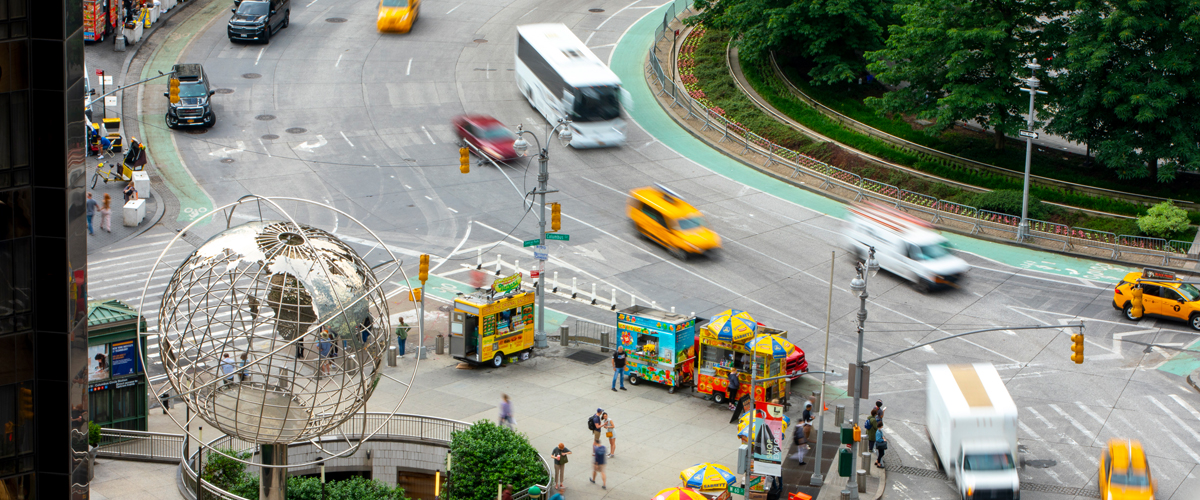
When New York City launched its long-debated congestion pricing program in January 2025, policymakers, commuters, business owners, and transportation advocates all had the same question: What would happen next?
Would drivers abandon their cars for public transit? Would traffic ease? Would the new tolls generate enough revenue to improve the region’s transportation infrastructure? And most importantly, how would millions of individual decisions add up to citywide change?
For electrical and computer engineering Ph.D. student Hailun (Helen) Wu, answering those questions became the foundation of a research project that has placed her at the forefront of transportation policy modeling and demonstrates the kind of high-impact, interdisciplinary research taking place at New York Institute of Technology.

Wu is the lead author of “GATEWAY: A Game Theory Model for Analyzing NYC Road Tolls and Commuter Response,” recently accepted for publication in IEEE Transactions on Intelligent Transportation Systems. Developed in collaboration with her advisor, Professor of Electrical and Computer Engineering Ziqian (Cecilia) Dong, Ph.D., and Roberto Rojas-Cessa, Ph.D., of New Jersey Institute of Technology, the project uses game theory and real-world transportation data to predict how commuters respond to road tolls and congestion pricing.
The research was funded by the National Science Foundation and is part of a broader effort in Dong’s Network and Innovation Laboratory on the New York City campus to develop data-driven tools that help policymakers make better decisions.
“This is something that affects our everyday life,” Wu says. “Whether you drive, take the subway, ride a bus, or even walk, transportation affects everyone. I wanted to work on something that has a direct impact on people and communities.”
A Real-World Problem
Congestion pricing was designed to tackle two major challenges facing New York City: chronic traffic congestion and the need for new funding to support public transportation.
But determining the right toll is tricky. Charge too little, and traffic may not decrease enough to make a meaningful difference. Charge too much, and the policy may create unintended economic burdens while generating less revenue than expected.
Traditional transportation models can estimate traffic demand, but they often fail to capture the dynamic relationship between policymakers and commuters. A toll changes behavior, and that behavior changes the effectiveness of the toll.
Wu wondered whether there was a better way to understand that interaction.
Her answer came from game theory, a mathematical framework used to analyze decision-making among multiple participants whose choices affect one another. Often associated with economics, negotiations, and strategic competition, game theory has also been applied to fields ranging from telecommunications to cybersecurity.
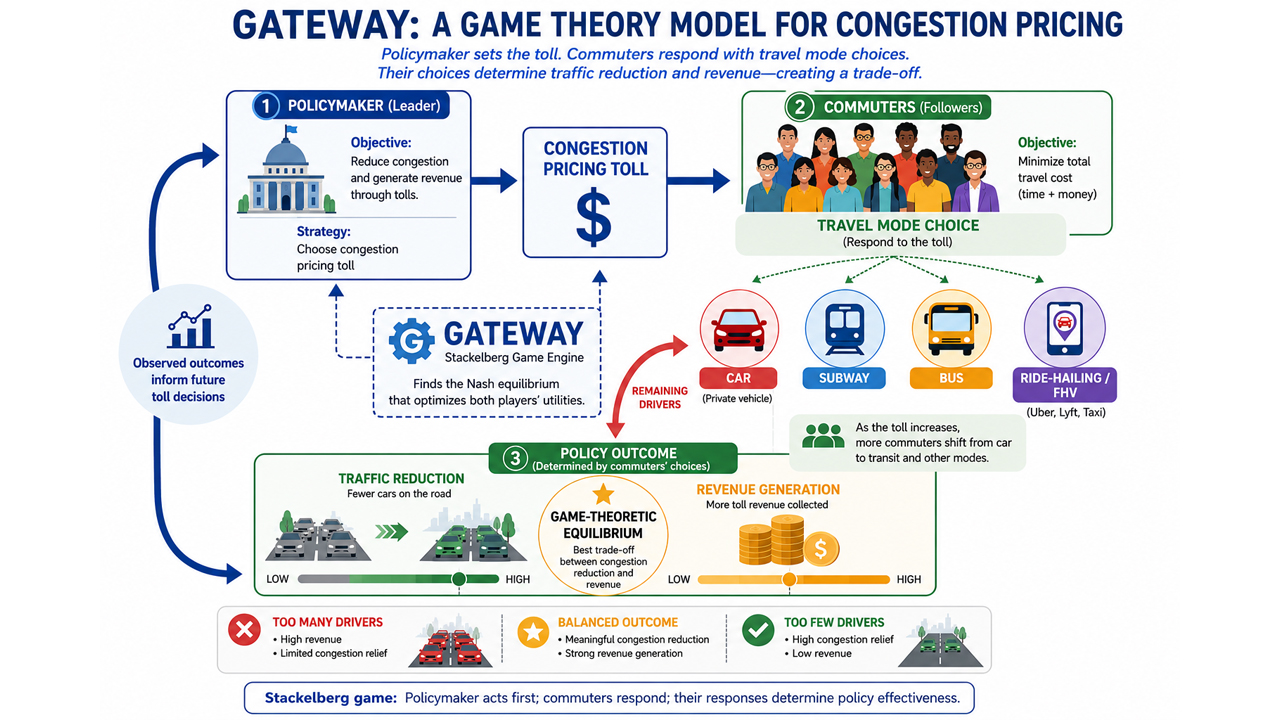
“Think of it like a chess game,” she explains. “The city makes the first move by setting a toll. Then commuters respond by deciding whether to drive, take the subway, take a bus, or use another mode of transportation. Each side’s decision affects the other.”
That interplay became the foundation of GATEWAY.
Building a New Model
Rather than rely solely on simulations, Wu created an entirely new model that treats transportation policy as a strategic game between two major players: policymakers and commuters.
The policymaker’s goal is to reduce congestion while generating revenue. Commuters seek to minimize the cost and time associated with their trips. GATEWAY analyzes how those competing objectives influence one another and identifies outcomes that balance both interests.
The model draws on publicly available transportation data, including travel surveys and traffic volume information from New York City’s Open Data platform. By combining those datasets with game theory principles, Wu was able to estimate how commuters would react under different toll scenarios.
According to Dong, the approach fills an important gap in existing transportation research.
“Academic research tends to focus either on quantitative or qualitative analysis, but transportation policy requires both to truly understand how policy and human behavior interact,” Dong says. “What we’re trying to do is bridge that gap. We want to give decision-makers data-backed tools to anticipate the effect of a policy before it’s implemented.
GATEWAY represents a significant innovation because it did not previously exist in the transportation-planning literature. “Most existing work is simulation-based or agent-based,” Dong says. “Helen’s model looks at behavior at a higher level, quantifying how people change strategies when pricing changes.”
Putting Theory to the Test
To validate GATEWAY, Wu tested it against two real-world case studies: New York City’s 2010 bridge and tunnel toll increase, which raised tolls on its seven bridges and two tunnels 5 percent for EZPass users and 18 percent for cash-paying drivers, and the implementation of congestion pricing in 2025, the first such policy in the nation.
The results were striking.
When analyzing congestion pricing, GATEWAY predicted approximately a 14 percent reduction in vehicle traffic. Actual measurements showed a reduction of roughly 12 percent. GATEWAY also suggested an optimal toll price of $10.44, close to the $9 price that was implemented.
For researchers attempting to model millions of individual travel decisions, that level of accuracy is notable. “We were very excited to see how close the prediction was,” Wu says.
The model also revealed insights that extend beyond traffic counts. One finding involved transportation equity.
By analyzing responses across income levels, Wu discovered that higher-income commuters generally had more flexibility when faced with congestion pricing. They could switch transportation modes, alter travel patterns, or absorb additional costs more easily.
“For some lower-income groups, driving may still be the only practical choice,” says Wu. “That raises questions about fairness and transportation equity.” Those findings highlight how data-driven research can inform policy discussions that extend beyond transportation and into broader social and economic considerations.
Learning Through Research
For Wu, the project represents the culmination of a long academic journey.
Originally from China, she came to New York Tech to pursue a master’s degree in electrical and computer engineering. After completing that degree, she began doctoral studies in 2022, becoming one of the first students in New York Tech’s new Ph.D. program in electrical and computer engineering.
Along the way, her interests evolved toward transportation systems, sustainability, and behavioral modeling. She realized that understanding human behavior is often the key to solving complex engineering problems.
Her dissertation explores travel behavior and transportation decision-making, including the challenges of working with large transportation datasets. Earlier in her doctoral work, she developed a data imputation model for cost estimates (DICE) to address missing cost information in travel surveys, helping improve the quality of transportation data used for forecasting.
Those efforts ultimately laid the groundwork for GATEWAY.
Dong credits Wu’s success to both intellectual curiosity and persistence. “She is very independent,” Dong says. “She takes initiative, comes up with new ideas, and is willing to do the hard work. This paper went through multiple revisions, and she was very persistent in addressing every question and concern. She’s becoming a truly independent researcher.”
Research With Impact
The project also reflects a broader philosophy within the College of Engineering and Computing Sciences: connecting advanced technical research with real-world challenges.
Dong’s lab focuses on network and innovation for sustainability, urban systems, and data-driven decision-making. Students work with actual city datasets and collaborate with researchers and agencies to develop practical solutions.
Rather than creating models based on hypothetical scenarios, researchers use real-world information to tackle issues ranging from transportation and urban flooding to environmental sustainability. That approach gives students opportunities to contribute meaningful work while still in graduate school.
For Wu, one of the most rewarding aspects of the project is knowing that her research could influence decisions affecting millions of people. After completing her degree in August, she plans to continue postdoctoral research in transportation and behavior modeling. “I think it’s very interesting to kind of peek into what people are doing through the data, like being nosy, but not too nosy,” she says. “Transportation is something we all use, and this kind of research could help the community guide their decision-making process.”
By Renée Gearhart Levy
More News
New York Tech To Be Ranked Among National Universities
For the 2027 U.S. News & World Report annual rankings, New York Tech will be included in a new ranking category—National Universities.
Robust Research
New York Tech’s commitment to research paves the way for important and groundbreaking work. Meet three Ph.D. students whose work may improve disaster response, recovery after muscle and bone injuries, and anticancer therapies.

Fellows’ Field Notes: Bofan He and Christine Lee
Edward Guiliano Global Fellowship recipients Bofan He and Christine Lee reflect on their experiences as they traveled to conduct academic research.
A SOURCE for Impressive Student Research
New York Tech’s 23rd Annual Symposium of University Research and Creative Expression (SOURCE) featured hundreds of students’ research and scholarly work.
Engineering Faculty to Collaborate with BNL Scientists
Five College of Engineering and Computing Sciences faculty members will engage in research collaborations with esteemed scientists as part of Brookhaven National Laboratory’s Visiting Faculty Program.
Examining the Role of Inequality in Human Migration
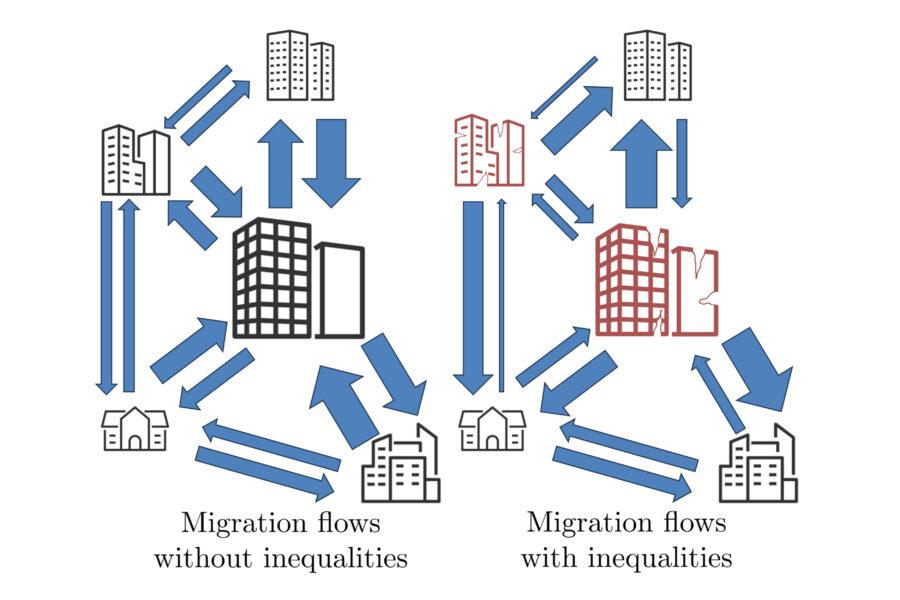
Mathematical models fall short in their predictions of migration. Associate Professor of Mechanical Engineering Alain Boldini, Ph.D., seeks to improve these models by including conflicts, natural disasters, and economic factors.