When Numbers Become Shapes
Many artists find creative inspiration in their environment—flora and fauna, the human experience, their travels, maybe just everyday life. And everyday life, for some artists, can involve computational outputs.

Such is the case for Ricardo Cabret (M.S. ’14), who studied computer science in the College of Engineering and Computing Sciences and has worked in the software engineering and development fields for more than a decade. Now, he focuses exclusively on his studio practice, which has begun demanding more of his time, as he has multiple exhibitions this year.
Cabret grew up in Puerto Rico surrounded by art, but he says the path to his current success was not easy. In fact, his background as a computer engineer—and the public perception that there’s a distinct separation between the technical and the creative—might be the biggest obstacle he has had to overcome. Today, his paintings are represented by major galleries, held in several permanent museum collections, and exhibited internationally, including a solo show in Tokyo in April.
Find out more about Cabret’s artistic journey and his endeavor to bridge the gap—whether real or imaginary—between technology and visual art.
How does your computer engineering background influence your creative side?
I worked remotely as a senior software engineer at [the video hosting platform] Vimeo for seven years. Before that, I had worked as a software developer at other companies. I’m used to switching contexts. My jobs always felt like practicing the syntax of coding; I use all that information in my studio.
In software development, it is normal to tinker and iterate through problems because often things don’t work as you thought they would, and you have to constantly think of what can go wrong. That’s how I approach painting. It’s a process of resolving conflicts. Coding is a rigid process; if it’s not written correctly, it doesn’t work. Painting is a freer medium. The canvas is not going to tell you, “Oh, it doesn’t work.” Whatever you put on the canvas, the canvas can take; it will not tell you it’s wrong.
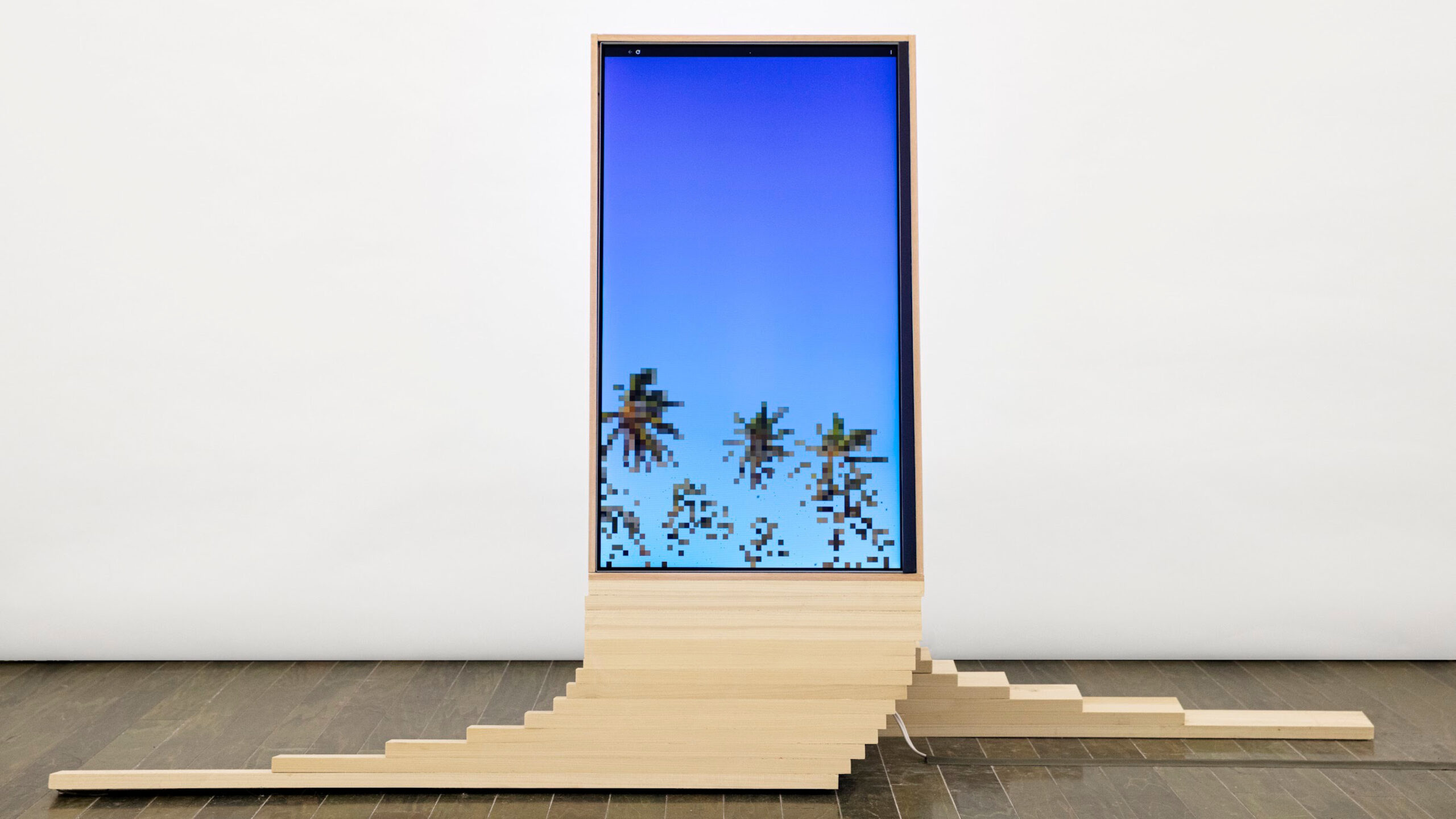
How does computer code translate into your physical paintings?
Nature has always been a point of input, specifically landscapes, but in addition, I look at outputs of algorithms, and those outputs generate ideas for compositions, colors, and shapes. A simple example could be coding a sine wave, which will render on the computer screen. I’ll use it as a visual spark to create compositions or mimic movement in a painting. I’m very interested in using code and generative graphics to visualize patterns of mathematical equations that I can then use as visual language. I’m turning this other dimension, based on linear algebra and geometry that exists all around us, into something physical you can look at.
I sometimes imagine how WiFi transmissions would look if they were visible and melded into the natural landscape. These concepts are extremely abstract. My work attempts to make that abstraction tangible.
That seems like a very unusual way to create art.
I reject the modern notion that science and art exist in isolation. This perceived divide is a social construct that limits our understanding of the world. My work operates in the space where these structures dissolve, demonstrating that when you strip away the labels, inquiry and expression are one and the same.
[Leonardo] Da Vinci and many other artists from the Renaissance era were scientists and painters at the same time. There was not a clear separation between the two disciplines. There’s a huge history that I’m building off of.
What role did New York Tech play in where you are today?
For the first time, I found myself truly captivated by my studies, surrounded by a community that understood my desire to merge technical skill with creative vision. A defining moment was collaborating with the architecture department to code 3-D graphics for skyscraper blueprint software. New York Tech provided the essential bridge between computer science and other disciplines, an experience that was truly transformative for me.
By Ashley Festa
More News
A Passion for Games, a Vision for Business
College of Engineering and Computing Sciences student Cody Ortiz helps his father run a florist shop, an endeavor that inspired him to become an entrepreneur, too.
Building Machines…and a Future
Mechanical engineering student Anthony Vazquez Rivas aspires to a career in HVAC, but it’s the projects he’s worked on along the way at New York Tech that inspired him to decide on the specialty.
Longtime Economist Finds His Way Into Nuclear Energy Sector
Dario Martinez (M.S. ’25) has spent most of his professional career as an economist, and over the past three years, the energy management alumnus has become one of the voices shaping the conversation around Puerto Rico’s energy grid.
SGA President Paves the Way for Current and Future Students
Student Government Association (SGA) President Yael Mendez Saavedra came to New York Tech because of its reputation and ended up enjoying his extracurricular leadership roles just as much as his studies.
Exploring Data and AI
Computer science graduate student Rudriben “Rudri” Trivedi attended two Google events in New York City to deepen her understanding of the field.
Using Technology for Good
Computer science student Edrich Silva wants a career in technology where he can practice his skills and create social good.