
Visualizing How Military Blasts Impact Unborn Babies
Pictured: Assistant Professor Milan Toma
A recent study by College of Osteopathic Medicine (NYITCOM) faculty and alumni provides new insight into how military blasts can injure unborn babies (fetuses) and how the amniotic fluid surrounding the fetus may provide protection. The findings, which were published in the journal Injury, could help doctors better assess fetal injuries and inform the development of future safety devices.
Pregnancy-related trauma is one of the leading causes of morbidity and mortality in pregnant women and their unborn babies. Recently, military conflicts in Eastern Europe and the Middle East, where there have been documented cases of airstrikes targeting maternity hospitals, have led scientists and medical professionals to consider how the forces of a military blast could impact unborn children.
Now, researchers, led by biomedical engineer and NYITCOM Assistant Professor Milan Toma, Ph.D., have used elaborate 3-D models to simulate the impact of an explosion beneath a motor vehicle. The models accounted for real patient-specific geometries and fluid-structure interaction in spaces between the inner lining of the uterus and fetus, placenta, and umbilical cord.
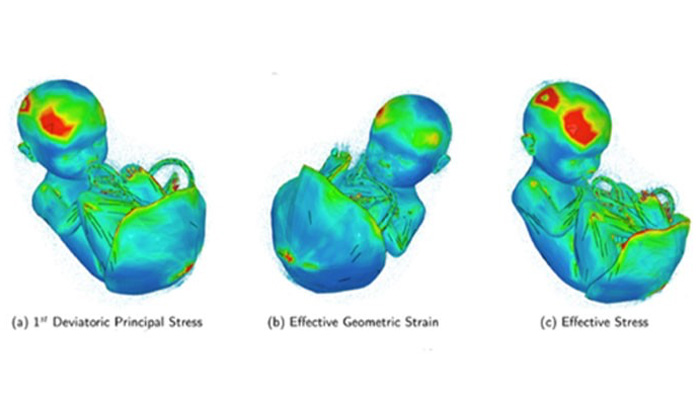
Their findings showed that amniotic fluid is crucial in protecting the fetus from trauma. While the simulated explosion subjected the outside of the uterus to multiple acceleration changes, the fetus (inside the uterus) experienced lesser acceleration changes. The models also showed that because the fetus was positioned with its head facing down and exposed to an explosion underneath the mother’s womb, the area around the skull sustained more stress.
The study was conducted in collaboration with Jonathan Arias (D.O. ’23) and Gregory Kurgansky (D.O. ’23), former NYITCOM students who have since completed their studies and advanced to residency programs. Other collaborators included Ong Chi Wei, Ph.D., from Singapore’s Institute of High Performance Computing, and Rosalyn Chan-Akeley, M.D., an OB-GYN affiliated with Lang Research Center at New York-Presbyterian Hospital Queens.
More Features

Forward-Thinking Design
Associate Professor of Architecture Clarke Snell, M.Arch., uses technology to link form and performance.

Students Step in to Help Save a Life
Students from the College of Osteopathic Medicine and the School of Health Professions provided life-saving medical care to a young mixed martial arts athlete.

Aldo Spano Named Recreation Director and Sprint Football Coach
Aldo Spano, a 20-year teaching and coaching veteran, has joined New York Tech as director of recreation and head sprint football coach.

Bringing Literature to Life
Professor of Humanities and New Your Tech’s second Distinguished Professor Jonathan Ezra Goldman dispels myths of the 1920s—and the myths students tell themselves.

Meet the 2026-2027 SGA Presidents
Yashvi Patel and Best Justus will serve as Student Government Association (SGA) presidents for the Long Island and New York City campuses, respectively.

An Explorer, Through and Through
Associate Professor of Management Kevin O’Sullivan, D.Sc., teaches skills so students can adapt to change with agility.